


Backup Manager Plugin
Automate database and file backups for October CMS to off-site storage — encrypted and restorable.
Demo URL: https://october-demo.renatio.com/backend/backend/auth/signin
Login: backup
Password: backup
The backup is a zip file with the directories you specify and a dump of your database, stored on any of the filesystems configured in October. The plugin cleans up old backups, monitors their health, notifies you when something goes wrong and restores the database from any backup it created.
Features
- A backup database and application files with mouse click
- Restore the database from any backup with a console command
- S3, FTP, SFTP, Dropbox storage support
- MySQL, PostgreSQL, SQLite and Mongo databases support
- A configurable scheduler for automatic backups
- Backups triggered over HTTP, for hosting without a system cron
- Queued backups that survive execution time limits
- A history of every backup run, with filters, bulk delete and automatic retention
- Per-action permissions
- Automatic cleanup of old backups
- Extensive settings options
- Encryption and password protection
- Verification of every created archive
- Monitoring the health of all backups
- Mail, Discord and webhook notifications
Requirements
This plugin requires PHP 8.3, with the ZIP module, October CMS 4.0 and Laravel 12.40 or higher. It's not compatible with Windows servers.
If you are using an older version of Laravel and October, take a look at one of the previous versions of this plugin.
The package needs free disk space where it can create backups. Ensure that you have at least as much free space as the total size of the files you want to backup.
mysqldump, pg_dump or mongodump must be installed for the database engine you back up.
Backup runs are serialized under a cache lock, which needs a cache store shared across processes: file, database
or redis. With the array store backups still run, but may overlap.
Why is this a paid plugin?
Something that is free has little or no perceived value. Users do not commit to free products and only use them until something else looks nice and is free comes along. When I invest my time in the development of a new plugin I commit to supporting and maintaining it. I ask my customers to do the same. I do not make money from this plugin by advertisements, upgrades or additional services like hosting or setup.
Did you know that 30% of your purchase or donation goes to help fund the October Project?
My plugins take many hours to develop (40-120+) and even more hours to document and maintain. My paid plugins have to pay for both this time, and the time I am spending on free plugins and less successful paid plugins. This means that it will take even a successful plugin years to become profitable. Please consider buying an extended license if you want me to continue to maintain these plugins for the very small fee I ask in return or hire me for adding functionality that you feel is missing but valuable.
Like this plugin?
If you like this plugin, give this plugin a Like or Make donation with PayPal.
My other plugins
Please check my other plugins.
Support
Please use GitHub Issues Page to report any issues with plugin.
Reviews should not be used for getting support or reporting bugs, if you need support please use the Plugin support link.
Icon made by Darius Dan from www.flaticon.com.
This plugin is also included into the following bundle


Installation via Command Line
php artisan plugin:install Renatio.BackupManager
Documentation
Usage
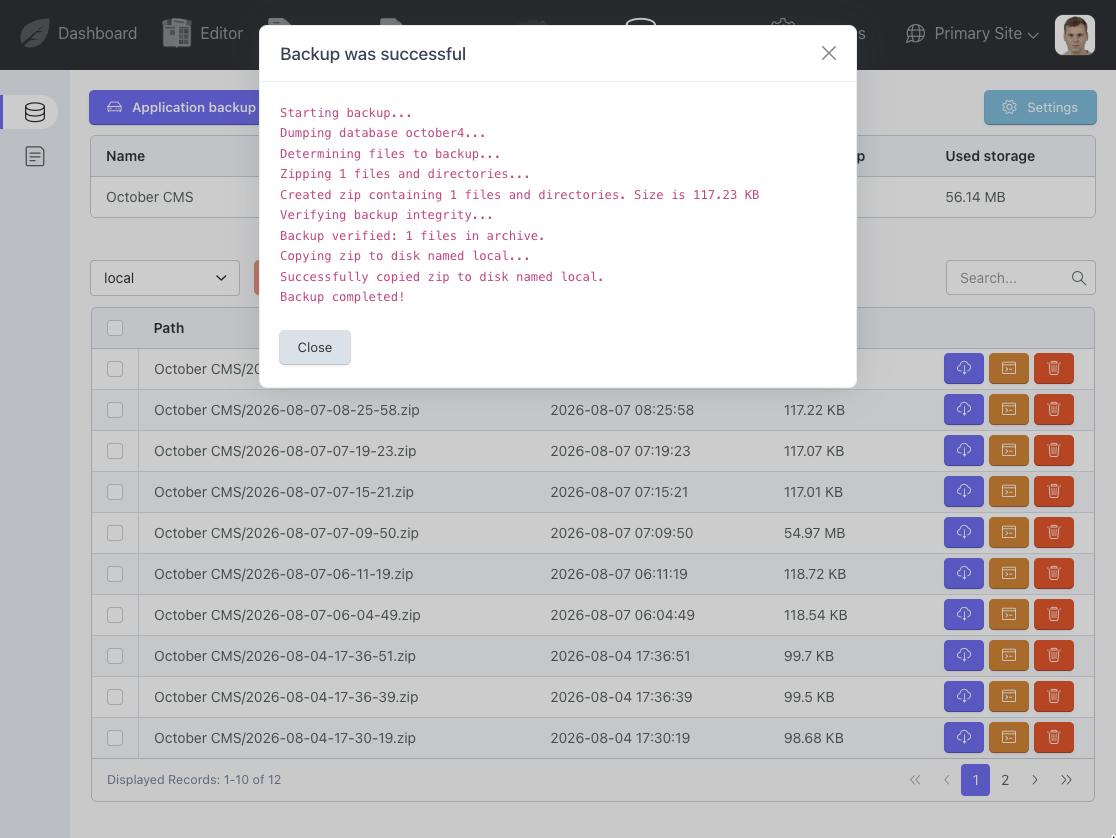
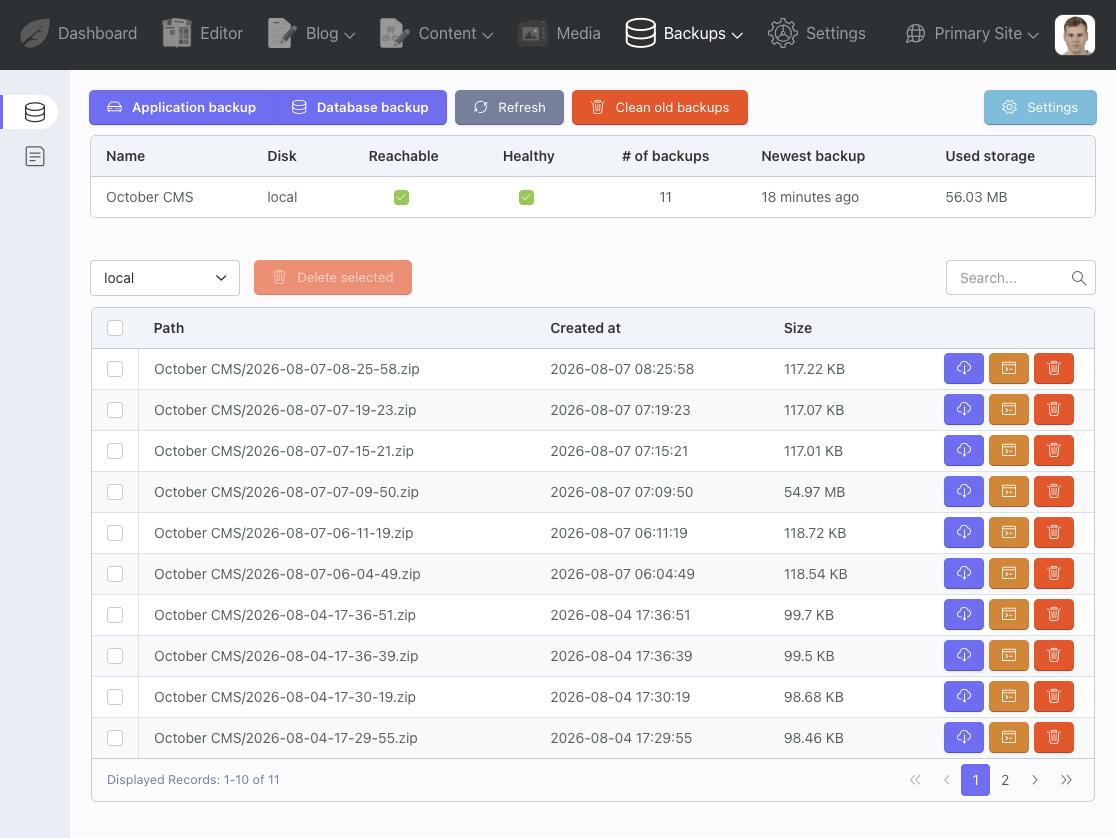
The plugin registers a Backups menu in the backend.
- Application backup creates a backup of all project files and the database. By default the project base path is backed up without vendor and node_modules; change that in the plugin Settings.
- Database backup creates a database-only backup.
- Clean old backups removes old backups according to the Cleanup settings.
Permissions
Access is granted per action under Settings → Administrators, on the Backups tab. Super users bypass all of them.
| Permission | What it unlocks |
|---|---|
| Manage backups | The backups page itself. Required for everything else on that page. |
| Create backups | The Application backup and Database backup buttons. |
| Clean old backups | The Clean old backups button. |
| Delete backups | The delete icon on each row, the checkboxes and Delete selected. |
| Download backups | The download icon, and the download route behind it. |
| Copy restore command | The terminal icon that copies the restore command. |
| Manage history | The History page itself. |
| Delete history entries | The delete icon on each row, the checkboxes, Delete selected and Clear history. |
| Manage settings | The plugin settings, and the Settings button in the toolbar. |
Copy restore command only hides the button. Restoring runs from the console, so anybody with shell access can restore regardless of this permission.
Restoring a backup
Restoring replaces your database with the one stored inside a backup archive. It is available from the console only, because it cannot be undone. The terminal button in the backups list copies the matching command to your clipboard.
php artisan backup:restore
php artisan backup:restore --path="October CMS/2026-01-15-09-20-58.zip" --disk=local
| Option | Description |
|---|---|
--path |
Path to the backup archive on the disk. Required when running non-interactively. |
--disk |
Disk the backup is stored on. Defaults to the disk selected in the backups list. |
--connection |
Database connection to restore into. Defaults to the application default. |
--password |
Password for an encrypted archive. Falls back to BACKUP_RESTORE_PASSWORD, then to the password saved in the settings; an interactive run asks when none fits. Also encrypts the safety backup. |
--skip-safety-backup |
Do not create a safety backup first. Leaves you without a way back. |
--force |
Skip the confirmation prompt. Required for unattended runs. |
Only the database is restored. Project files inside the archive are never touched.
You will be logged out. The dump contains
backend_usersandsessions, so accounts return to the state they were in when the backup was taken.Restoring is not transactional. An import that fails halfway leaves the database inconsistent, which is why a safety backup is taken first - keep the path it prints.
A few things to know:
- Anything passed as
--passwordshows up inpsand the shell history; on a shared server useBACKUP_RESTORE_PASSWORDor let the command ask. - The safety backup is encrypted only with
--password, never with the password from the settings, because that one lives in the database being replaced. Without--passwordit is stored in plain form - delete it once you have verified the restore. - The restore waits for no other backup: if one is running, it stops before touching the database.
- Tables not present in the dump are left untouched.
- When the archive holds several dumps, the one matching
--connectionis used, by database name first and connection name second. If none matches, the restore stops and lists what the archive contains. - PostgreSQL and SQLite dumps contain no drop statements, so they can only be restored into an empty database.
- The native client -
mysql,psqlorsqlite3- must be inPATH, andproc_openenabled.
If the application no longer boots
A safety backup taken without --password can be imported without this application:
unzip -p "storage/app/October CMS/safety-2026-01-15-09-20-58.zip" "db-dumps/*.sql" > /tmp/recover.sql
mysql -u USER -p DATABASE < /tmp/recover.sql
Maximum execution time error
A Maximum execution time of ... seconds exceeded error means the backup is too large to finish in a single web request. You can:
- Raise max_execution_time in your PHP configuration.
- Use the Scheduler (recommended).
- Use Console commands.
- Enable Queued backups.
Queued backups
Enabling Queue backups on the Destination tab runs backend backups through the queue, so the request returns immediately and the backup continues in the background. This requires a running queue worker:
php artisan queue:work
Only a flash message is shown after clicking; open the History page to see the output once the job completed.
Leave this setting off if you do not run a queue worker, otherwise backups started from the backend will never run.
Backup history
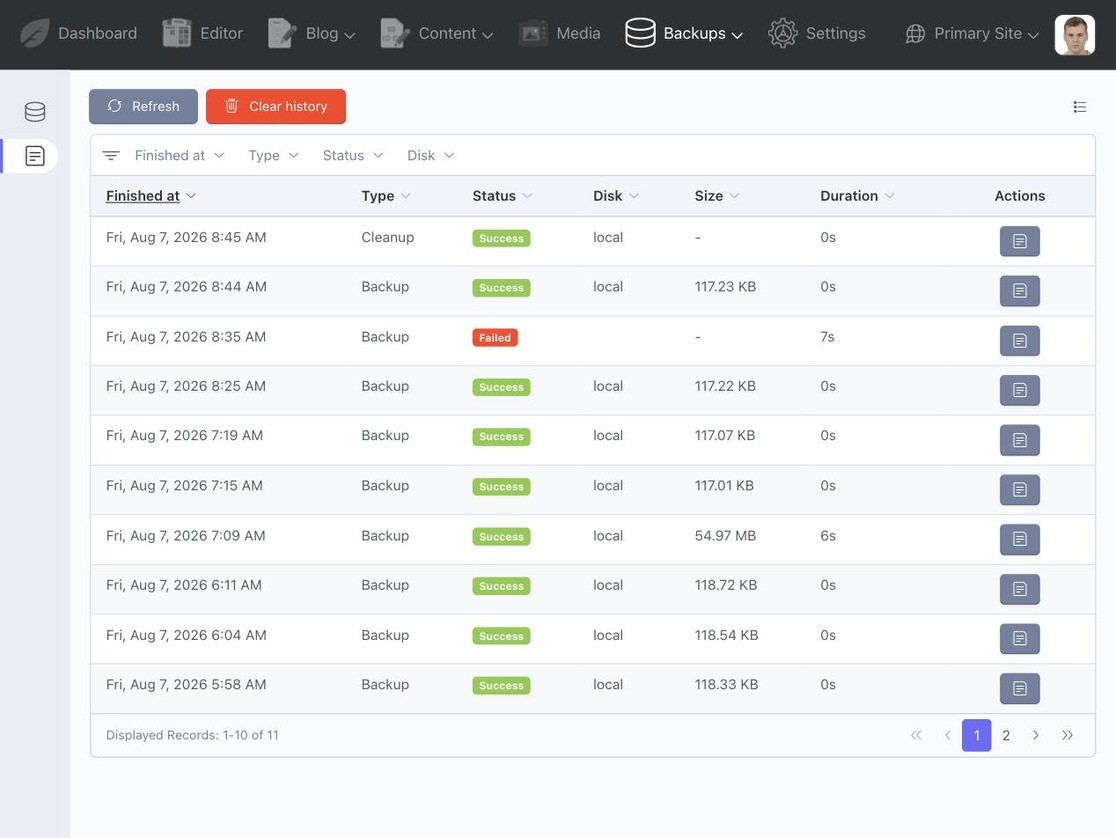
The History page records every backup and cleanup run: when it happened, how long it took, how large the archive was and whether it succeeded. Clicking an entry shows the output of that run.
The history is a journal of what the plugin did, not a list of the archives that exist - the backups list always reads the disk. Removing an entry, selected entries or the whole history never touches the archives. Entries expire according to Keep history entries for days in the settings.
Settings
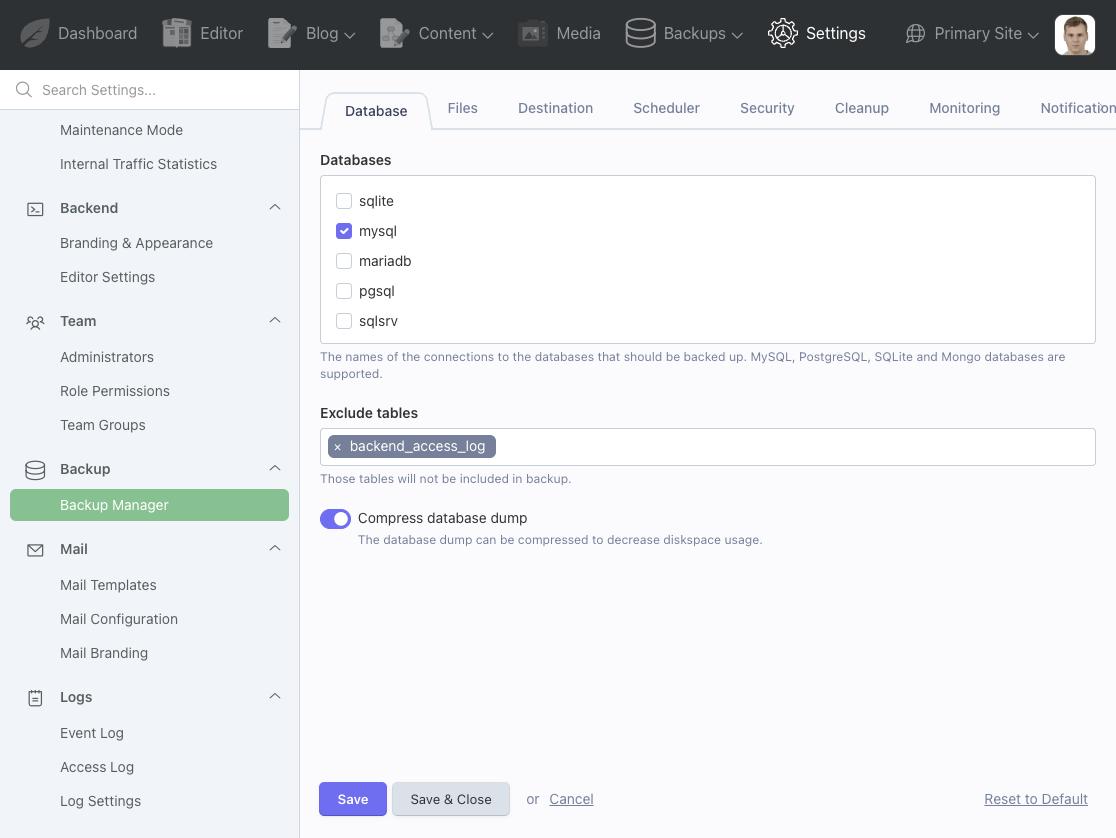
Go to Settings and open Backup Manager under the Backup section.
Database
| Property | Description |
|---|---|
| Databases | The names of the connections to the databases that should be backed up. MySQL, PostgreSQL, SQLite and Mongo databases are supported. |
| Exclude tables | Those tables will not be included in backup. |
| Compress database dump | The database dump can be compressed to decrease disk space usage. |
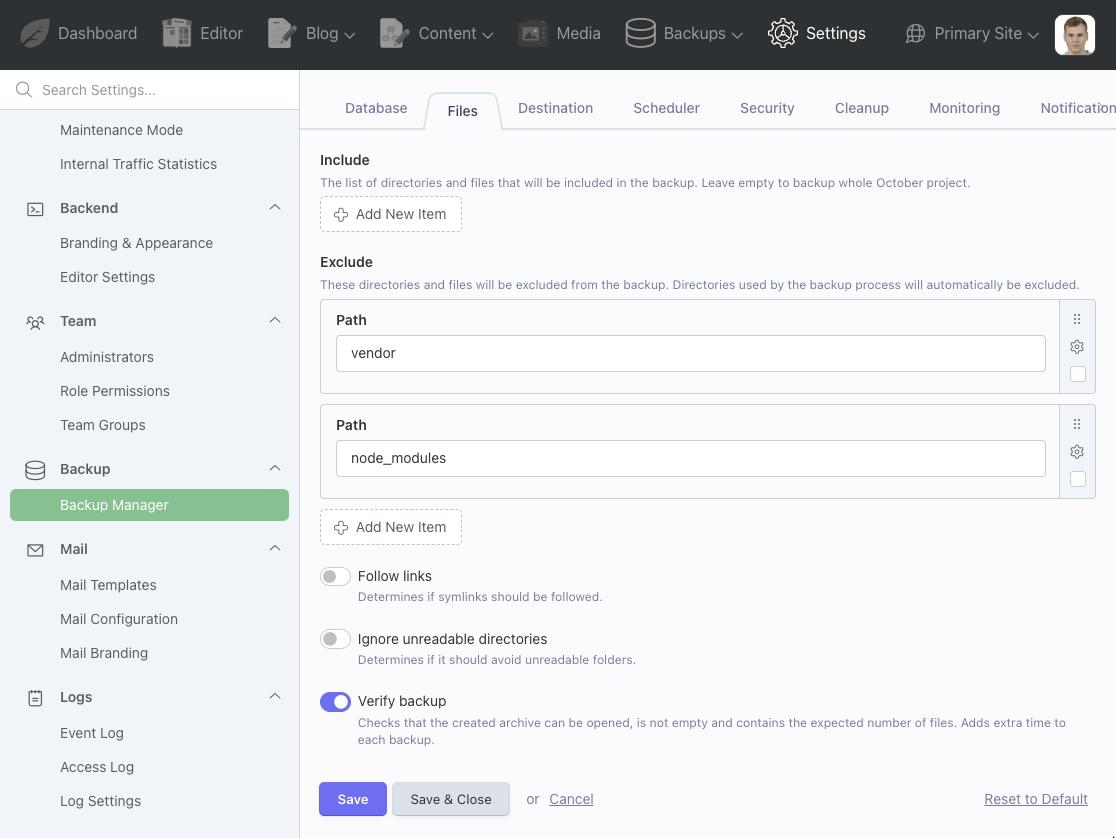
Files
| Property | Description |
|---|---|
| Include | The list of directories and files that will be included in the backup. Leave empty to backup whole October project. |
| Exclude | These directories and files will be excluded from the backup. Directories used by the backup process will automatically be excluded. |
| Follow links | Determines if symlinks should be followed. |
| Ignore unreadable directories | Determines if it should avoid unreadable folders. |
| Verify backup | Checks that the created archive can be opened, is not empty and contains the expected number of files. Adds extra time to each backup. |
Destination
| Property | Description |
|---|---|
| Filename prefix | The filename prefix used for the backup zip file. |
| Name | The name of this application. |
| Disks | The disk names on which the backups will be stored. |
| Queue backups | Runs backups through the queue instead of the web request. |
Scheduler
Configure how often the plugin runs the database backup, application backup, cleanup and health monitor.
Important note: For scheduled tasks to operate correctly you must set up the scheduler: https://docs.octobercms.com/4.x/setup/scheduler.html
Allow external trigger
For hosting without a system cron, Allow external trigger publishes three addresses that run the tasks over HTTP:
https://example.com/backupmanager/trigger/<token>/db
https://example.com/backupmanager/trigger/<token>/app
https://example.com/backupmanager/trigger/<token>/clean
Point an external cron service (cron-job.org, EasyCron, an uptime monitor) at the one you need. A 200 means the
task ran, a 500 means it failed.
The address is the password. Anybody who knows it can run the task, so keep it out of tickets, screenshots and anything else that gets shared. If it leaked, Generate new addresses replaces the token and every old address stops working at once. Switching the trigger off disables the addresses immediately.
Use HTTPS only - the token travels in the URL and ends up in server, proxy and cron service logs. When the calling
service can send headers, call https://example.com/backupmanager/trigger/db (or app, clean) with an
X-Backup-Token header instead.
The endpoint answers 404 to a wrong token, an unknown task and a disabled trigger alike, and limits requests to five
per minute per IP address and ten per minute across all addresses combined. With Queue backups enabled it returns
as soon as the task is queued, and only one job per task waits in the queue at a time.
Security
Password
Password-protects the archive. Use a long string and keep it safe - without it, you will never be able to open your backup. Leave it blank for an unprotected archive.
Secrets in the file backup
With the default settings the file backup contains the whole project, including .env with APP_KEY, database
credentials and storage keys. Without an archive password anyone who can read the backup can read the secrets.
Either set an archive password, or add .env to the Exclude list if your hosting recreates it. The backups page
warns as long as .env is backed up without a password.
Encryption
Test decrypting an archive once, so you know the restore path works before you need it.
Warning: the default macOS archive utility cannot open encrypted ZIP files. Use The Unarchiver or BetterZip.
Cleanup
| Property | Description |
|---|---|
| Keep all backups for days | The number of days for which backups must be kept. |
| Keep daily backups for days | The number of days for which daily backups must be kept. |
| Keep weekly backups for weeks | The number of weeks for which one weekly backup must be kept. |
| Keep monthly backups for months | The number of months for which one monthly backup must be kept. |
| Keep yearly backups for years | The number of years for which one yearly backup must be kept. |
| Delete oldest backups when using more megabytes than | After cleaning up the backups remove the oldest backup until this amount of megabytes has been reached. |
| Keep history entries for days | History entries older than this number of days are removed daily by the scheduler. Set to 0 to keep the history forever. |
Monitoring
A backup is considered unhealthy when the latest backup is too old or the backups use more storage than allowed.
| Property | Description |
|---|---|
| Newest backups should not be older than days | Send a notification when newest backup will be older than given days. Default to 1 day. |
| Storage used may not be higher than megabytes | Send a notification when storage used for backups will be higher than given megabytes. Default to 5000 megabytes. Setting to 0 means the monitor will consider that the backup can use unlimited storage. |
Dumping the database
If mysqldump / pg_dump is not in a default location, or the dump exceeds the default 60 second timeout, configure
the connection in config/database.php:
'connections' => [
    'mysql' => [
        'driver' => 'mysql'
        ...,
        'dump' => [
           'dump_binary_path' => '/path/to/the/binary', // only the path, so without `mysqldump` or `pg_dump`
           'use_single_transaction',
           'timeout' => 60 * 5, // 5 minute timeout
           'exclude_tables' => ['table1', 'table2'],
           'add_extra_option' => '--optionname=optionvalue',
        ]
    ],
Configuring the backup disk
By default backups are saved to storage/app/October CMS/. Create a dedicated disk (for example backups) in
config/filesystems.php and select it in the plugin Settings.
Filesystems
Supported storage drivers: local, S3, FTP, SFTP and Dropbox. Configure the disk in config/filesystems.php, then
select it on the Destination tab of the plugin Settings.
S3
composer require league/flysystem-aws-s3-v3 "^3.0"
A sample s3 disk is included in config/filesystems.php.
FTP
composer require league/flysystem-ftp "^3.0"
'ftp' => [
    'driver' => 'ftp',
    'host' => env('FTP_HOST'),
    'username' => env('FTP_USERNAME'),
    'password' => env('FTP_PASSWORD'),

    // Optional FTP Settings...
    // 'port' => env('FTP_PORT', 21),
    // 'root' => env('FTP_ROOT'),
    // 'passive' => true,
    // 'ssl' => true,
    // 'timeout' => 30,
],
SFTP
composer require league/flysystem-sftp-v3 "^3.0"
'sftp' => [
    'driver' => 'sftp',
    'host' => env('SFTP_HOST'),

    // Settings for basic authentication...
    'username' => env('SFTP_USERNAME'),
    'password' => env('SFTP_PASSWORD'),

    // Settings for SSH key based authentication with encryption password...
    'privateKey' => env('SFTP_PRIVATE_KEY'),
    'password' => env('SFTP_PASSWORD'),

    // Optional SFTP Settings...
    // 'hostFingerprint' => env('SFTP_HOST_FINGERPRINT'),
    // 'maxTries' => 4,
    // 'passphrase' => env('SFTP_PASSPHRASE'),
    // 'port' => env('SFTP_PORT', 22),
    // 'root' => env('SFTP_ROOT', ''),
    // 'timeout' => 30,
    // 'useAgent' => true,
],
Dropbox
Install the Dropbox Adapter plugin and configure the disk as described in its documentation.
Console commands
backup:run- run a backup;--only-dbbacks up only the databasebackup:clean- clean old backupsbackup:list- display the status of all monitored destination filesystemsbackup:monitor- check the health of all monitored destination filesystemsbackup:restore- restore the database from a backup archive, see Restoring a backup
Notification channels
Notifications go out by e-mail, to Discord and to any service accepting a webhook. A channel is used once it has an address; leave a field empty to disable it. Configure them on the Notifications tab of the plugin Settings.
| Setting | Description |
|---|---|
| Notification email | Addresses that receive notifications, separated with a comma. |
| Discord webhook URL | Create it in your Discord server under Integrations. |
| Webhook URL | Notifications are posted as JSON. Works with Slack, Mattermost, Microsoft Teams and custom integrations. |
A notification is sent when a backup or cleanup succeeds or fails, and when the monitor finds a healthy or unhealthy backup.
-

schote
Found the plugin useful on 16 May, 2026
Except the cron jobs it works and does its job.
-

Renatio author
Replied on 11 Aug, 2026
Thanks for the review! Scheduled backups run through the October CMS scheduler, which needs a single system cron entry on the server — see Setting Up the Scheduler. Once that entry is in place, the schedules from the Scheduler tab run on their own, and each run's output is attached to its history entry, so you can see what happened.
If your hosting doesn't allow a system cron, switch on Allow external trigger (since v7.1.0). It gives you secret URLs that run a backup or cleanup over HTTP, so any external cron service (cron-job.org, an uptime monitor, etc.) can trigger them on a schedule.
If the cron jobs still give you trouble, please open an issue on the GitHub Issues page and I'll help you get them running.
-

Myjestic
Found the plugin useful on 16 May, 2021
Really nice Plugin, after I got rid of some problems. Maybe this could help the developer or other users to make it work if this problems occur.
1) execution timeout / memory limit Edit "plugins\renatio\backupmanager\vendor\spatie\laravel-backup\src\Commands\BackupCommand.php" and add the following lines and adjust the values to your needs:
        ini_set("memory_limit",4000);
        set_time_limit(300);
        ini_set('default_socket_timeout', 6000);
2) 504 Gateway Timeout I figured out, that this error occure if you enable the password encryption. Password encryption will be executed by "laravel-backup-shild". Replace the folder "src" in "plugins\renatio\backupmanager\vendor\olssonm\laravel-backup-shield\" with the newest version on "https://github.com/olssonm/laravel-backup-shield".
-
Renatio author
Replied on 11 Aug, 2026
Thank you for the detailed write-up! It refers to a 2021 version of the plugin, and both problems have since been solved properly. Please don't patch files under
vendor/, because every plugin update silently reverts such changes.1) Execution timeout / memory limit. A large backup no longer has to fit into a single web request. Run it from the Scheduler, from the console, or turn on Queue backups on the Destination tab (since v6.4.0), so it continues in the background. The Maximum execution time error section of the documentation lists all the options.
2) 504 with password encryption. The laravel-backup-shield package is gone. Encryption is now built in and applied while the archive is created, instead of re-compressing it afterwards, so setting a password no longer causes gateway timeouts.
If anything still misbehaves on a current version, please open an issue on the GitHub Issues page and I'll look into it.
-

PrestaSafe
Found the plugin useful on 7 Aug, 2019
Great plugin thanks ! Do you plan an restore backup options ?
-
Renatio author
Replied on 11 Aug, 2026
Thank you! Six years later the answer is finally yes. Since v6.5.0 the plugin ships a
backup:restoreconsole command that restores the database from any backup archive, and the backups list has a button that copies the matching command to your clipboard.Restoring is console-only on purpose, because it can't be undone. It replaces only the database (project files are never touched) and takes a safety backup first, so you have a way back. The Restoring a backup section of the documentation covers all the options and safety notes.
-

Web Master
Found the plugin not useful on 15 May, 2019
Doesn't Work anymore
-
Renatio author
Replied on 17 May, 2019
Sorry to hear it stopped working for you. Unfortunately the review doesn't say what went wrong, and when I tested the plugin on the latest October CMS build it worked as expected, so I couldn't reproduce the problem.
The plugin has been actively maintained ever since and is regularly updated for new October CMS releases. If you give the current version a try and something doesn't work, please open an issue on the GitHub Issues page with the error message and your October CMS and PHP versions, and I'll look into it.
-

Javier Offshore
Found the plugin useful on 16 Jan, 2019
Hello good afternoon I bought the 2FA plugin I have the following problem: How can I force other users to activate 2FA every time they enter the backend?
Awaiting your reply
-
Renatio author
Replied on 11 Aug, 2026
This review seems to have landed on the wrong plugin. Backup Manager makes backups and has nothing to do with 2FA, and the 2FA plugin mentioned here wasn't one of mine.
If you're looking for the same thing today: my Two-Factor Authentication plugin has Require 2FA for all users on the Enforcement tab of its settings. It makes every backend user set up 2FA at their next sign-in, and after that they're asked for a code every time they log in.
For backup-related questions, please use the GitHub Issues page.
-

Trias Nur Rahman
Found the plugin useful on 14 Sep, 2018
Very great plugin! It would be better if there is a notification (email) when something wrong in backup process :) Thanks!
-
Renatio author
Replied on 19 Jun, 2020
Thanks! Your suggestion made it into the plugin: since v3.3.0 it sends an e-mail when a backup or cleanup fails, and also when it succeeds.
It has grown since then. Notifications can also go to Discord or to any webhook (Slack, Mattermost, Microsoft Teams and custom integrations). The monitor warns you when the newest backup is too old or the backups use too much storage. Set it all up on the Notifications tab of the plugin settings. The details are in the Notification channels section of the documentation.
-

Reanatus
Found the plugin not useful on 25 May, 2018
BUG
"Type error: Argument 1 passed to Spatie\Backup\Tasks\Backup\BackupJobFactory::createDbDumpers() must be of the type array, null given, called in /var/www/html/plugins/renatio/backupmanager/vendor/spatie/laravel-backup/src/Tasks/Backup/BackupJobFactory.php on line 14" on line 25 of /var/www/html/plugins/renatio/backupmanager/vendor/spatie/laravel-backup/src/Tasks/Backup/BackupJobFactory.php
-
Renatio author
Replied on 27 May, 2018
Sorry you ran into this. The error appeared after an October CMS update when the plugin settings had no database connection selected, so the backup got an empty list of databases. At the time the fix was to reset the plugin settings to default and pick the database connection again (see issue #6).
The current version can't hit this anymore: when no connection is selected, it falls back to the application's default database.
If you run into any other problem, please open an issue on the GitHub Issues page, where I can reply quickly and the fix stays visible to other users.
-

Andy Barker
Found the plugin useful on 30 Dec, 2017
This is a great plugin which does exactly what you require from a backup plugin. Everything worked first time without a problem. Well worth the price.
Thank you to Renatio / Michel who has been super responsive to a special request I had.
-
Renatio author
Replied on 11 Sep, 2026
Thanks a lot, Andy — really appreciated, and sorry it took me so long to reply! I'm glad everything worked out of the box and that I could help with your request.
The plugin is still actively maintained. Since your review it has gained restoring from the console, notifications to e-mail, Discord and webhooks, queued backups and an external trigger for hosting without a system cron. If you ever need anything else, the GitHub Issues page is the quickest way to reach me.
-

sunil chaulagain
Found the plugin useful on 1 Nov, 2017
Hi , I just installed the plugin but its not working . It makes backup with db but not files. My include files repeater doesn't have anything. I am not sure what's going on. Thanks
-
Renatio author
Replied on 1 Nov, 2017
Hi Sunil, sorry for the trouble. An empty Include list is fine: it means the whole October project is backed up. The files only end up in the archive when you use Application backup. Database backup creates a database-only archive, so that's the usual reason for a backup without files.
If Application backup also leaves the files out on a current version, please open an issue on the GitHub Issues page and I'll look into it.
-

Dan Miles
Found the plugin useful on 17 May, 2017
Brilliantly easy, super reliable and generally couldn't do without it.
-
Renatio author
Replied on 11 Sep, 2026
Thanks a lot, Dan — "couldn't do without it" is the best thing a backup plugin can hear! Sorry it took me so long to reply.
The plugin is still actively maintained. Since your review it has gained restoring from the console, notifications to e-mail, Discord and webhooks, and queued backups. If you ever run into anything or have an idea, the GitHub Issues page is the quickest way to reach me.
-

Brian N
Found the plugin useful on 30 Dec, 2016
This is a very good must have plugin. I agree with the other reviews though about wanting a way to upload a backup that is not in the database.
-
Renatio author
Replied on 11 Aug, 2026
Thank you! This one has long been solved. The backups list is no longer stored in the database: it shows every backup archive found on the configured disks. Put an archive on any of them (local, S3, FTP, SFTP or Dropbox, in the same folder as the other backups, by default
storage/app/October CMS/on the local disk), and it appears in the list like any other backup.Since v6.5.0 you can also restore the database from such an archive with the
backup:restoreconsole command. See the Restoring a backup section of the documentation. -

Toby Catlin
Found the plugin useful on 26 Jul, 2016
Its a good plugin but in my opinion has a fatal flaw (unless i am missing something).
The backup archives are listed in the database which means you cannot upload a backup that you have previously downloaded and stored elsewhere. So it works fine if you want to roll back to a previous state but if you wanted to reinstate the application from scratch you have to insert db rows to get the backups to display. It would not be hard to implement a backup import/upload feature.
-
Renatio author
Replied on 11 Sep, 2026
Thanks, Toby — you were right, and sorry it took me so long to reply! That flaw is long gone. The backups list is no longer stored in the database: it shows every backup archive found on the configured disks. Put a previously downloaded archive back on any of them (local, S3, FTP, SFTP or Dropbox, in the same folder as the other backups) and it appears in the list, no database rows needed.
For reinstating from scratch: since v6.5.0 the
backup:restoreconsole command restores the database from any such archive. Project files are never overwritten automatically, so you extract them from the archive yourself. See the Restoring a backup section of the documentation for the details. -

Potting Shed
Found the plugin useful on 16 Dec, 2015
Mindblowing plugin and excellent support from Renatio. This is simply a must for any serious OctoberCMS developer.
-
Renatio author
Replied on 11 Sep, 2026
Thank you so much — that means a lot, and sorry it took me so long to reply! It's great to know the plugin and the support made a difference.
Ten years later the plugin is still actively maintained and keeps growing: restoring from the console, notifications to e-mail, Discord and webhooks, queued backups and more. If you ever need anything, the GitHub Issues page is the quickest way to reach me.
-

zack
Found the plugin useful on 20 Aug, 2015
Can't remember how many times backup feature saved my life and that plugin allow me manage all backups in backend. Also Michal (developer) giving fast good feedbacks! Thank you
-
Renatio author
Replied on 11 Sep, 2026
Thanks, Zack — a backup plugin can't hope for better praise than "saved my life", and sorry it took me so long to reply! Glad the support helped too.
Managing backups from the backend has come a long way since then: the list now shows every archive on the configured disks, backups can run in the queue, and a failed backup can notify you by e-mail, Discord or webhook. If you ever need anything, the GitHub Issues page is the quickest way to reach me.
-

Joel Hernandez
Found the plugin useful on 2 Jul, 2015
Is a mistake for developers around the world, not to consider the backups of your application and database. Nowadays, the chances to lose information is huge. This plugin is amazing. Remember to install mysql package in your webserver, if you have 2 different servers: (one for webserver and one for database server)...
-
Renatio author
Replied on 11 Sep, 2026
Thanks, Joel — couldn't agree more, and sorry it took me so long to reply! Your tip still holds: the database is dumped with the native client (
mysqldumpfor MySQL,pg_dumpfor PostgreSQL), so it has to be installed on the web server even when the database runs on a separate one.If the client is installed outside the default location, or large dumps hit the timeout, you can set the binary path and timeout per connection. See the Dumping the database section of the documentation.
-

Alex Bass
Found the plugin useful on 8 Jun, 2015
This is EXACTLY what I was looking for. I am currently using DigitalOcean with Laravel Forge and this works perfectly. Must have app on every October site. Just purchased it for a couple projects. Have been hoping that DigitalOcean offered easy database and application backups but they have been really slow to implement that functionality so this app is PERFECT.
Can't thank you enough. Very happy with this and keep up the killer work. I'll be supporting this plugin with every project and highly recommending it to others.
Cheers!
-
Renatio author
Replied on 11 Sep, 2026
Thanks a lot, Alex — this made my day, and sorry it took me so long to reply! Great to hear it fits your DigitalOcean + Forge setup so well.
It fits even better today. Backups can go straight to off-site storage (S3, FTP, SFTP or Dropbox), so they don't live on the same droplet as the site. The scheduler runs them automatically, and a notification by e-mail, Discord or webhook tells you when something goes wrong. If you ever need anything, the GitHub Issues page is the quickest way to reach me.
-


| 7.3.0 |
Run the safety backup under the shared backup lock and encrypt it with the password given to backup:restore. Aug 22, 2026 |
|---|---|
| 7.2.2 |
Keep backup activity messages out of the system event log. Aug 14, 2026 |
| 7.2.1 |
Send notifications from the sender configured in the backend mail settings instead of the one from the environment file. Aug 12, 2026 |
| 7.2.0 |
Serialize every backup run under one shared lock so runs from the backend, the scheduler, the queue and the external trigger no longer overlap. Aug 11, 2026 |
| 7.1.0 |
Run backups from an external cron service through a secret URL, for hosting without a system cron or console access. Aug 11, 2026 |
| 7.0.0 |
Replace the two coarse permissions with granular ones and enforce them in every handler. Review your administrator roles after updating. Aug 11, 2026 |
| 6.7.1 |
Delete selected history entries, or a single one, instead of only clearing everything. Report what actually happened when deleting a backup. Aug 11, 2026 |
| 6.7.0 |
Rebuild the history page with date, type, status and disk filters. Prune history entries after a configurable retention period. Paginate the backups list. Improve the restore hints. Fix backup verification failing on broken symlinks. Aug 11, 2026 |
| 6.6.4 |
Report a truncated or partially damaged compressed dump as corrupt. Require a full name match when picking a dump out of an archive. Aug 11, 2026 |
| 6.6.3 |
Stop a failed SQLite restore halfway. Name the safety backup disk in the rollback hint. Decompress dumps without holding them in memory. Refresh the settings in queued backups. Aug 11, 2026 |
| 6.6.2 |
Restrict the backups list to configured disks. Fix dump matching for PostgreSQL and for several dumps of one client. Stop encrypting the archive twice. Aug 11, 2026 |
| 6.6.1 |
Escape backup names in the backend. Validate the notification email. Fix a blank custom cron breaking the scheduler. Store the matching log with each history entry. Aug 11, 2026 |
| 6.6.0 |
Record a history of backup runs and speed up the backups list. Aug 11, 2026 |
| 6.5.0 |
Add the backup:restore console command. Copy the restore command from the backups list. Keep the plugin working when the database is unreachable. Aug 11, 2026 |
| 6.4.0 |
Run backups through the queue when enabled in the settings. Aug 11, 2026 |
| 6.3.0 |
Send backup notifications to Discord and to a generic webhook. Aug 11, 2026 |
| 6.2.0 |
Cover the backend handlers with tests. Fix an error when switching disks without a selection. Aug 11, 2026 |
| 6.1.0 |
Support Laravel 13 and spatie/laravel-backup 10. Fix backup list error when no disk is configured. Aug 11, 2026 |
| 6.0.4 |
Add tests. Aug 11, 2026 |
| 6.0.3 |
Fix password protection error. Oct 20, 2025 |
| 6.0.2 |
Update dependencies. Jul 12, 2025 |
| 6.0.1 |
Require October 4. Jul 12, 2025 |
| 5.1.9 |
Fix backup encryption with password. Sep 25, 2023 |
| 5.1.8 |
Improve code quality. Nov 18, 2022 |
| 5.1.7 |
Bump dependencies. Nov 02, 2022 |
| 5.1.6 |
Reorganize settings. Oct 13, 2022 |
| 5.1.5 |
Minor fix. Jun 20, 2022 |
| 5.1.4 |
Minor fix. Jun 20, 2022 |
| 5.1.3 |
Improve support for Turbo Router. Jun 16, 2022 |
| 5.1.2 |
Improve UI. Custom cron expression for scheduler. Jun 16, 2022 |
| 5.1.1 |
Minor fix. Jun 14, 2022 |
| 5.1.0 |
Fix mail notifications. Jun 14, 2022 |
| 5.0.3 |
Docs. Jun 09, 2022 |
| 5.0.2 |
Minor fix. Jun 07, 2022 |
| 5.0.0 |
Require October CMS 3.0. Jun 07, 2022 |
| 4.3.0 |
Require October CMS 2.1. Dec 08, 2021 |
| 4.2.3 |
Polish language. Dec 01, 2021 |
| 4.2.2 |
Update docs. Sep 26, 2021 |
| 4.2.1 |
Set configuration defaults. Sep 14, 2021 |
| 4.2.0 |
Support OctoberCMS 2.0. Sep 11, 2021 |
| 4.1.0 |
Rewrite plugin core. Sep 11, 2021 |
| 4.0.1 |
Add option to ignore unreadable directories. Sep 11, 2021 |
| 4.0.0 |
!!! Add support for Laravel 6. Only update for Laravel 6 and October >= 1.1! Sep 11, 2021 |
| 3.3.4 |
Elevate plugin permission. Sep 16, 2020 |
| 3.3.3 |
Fix memory limit check. Jul 03, 2020 |
| 3.3.2 |
Fix listing database tables in settings. Jun 26, 2020 |
| 3.3.1 |
Improve mail notifications. Jun 19, 2020 |
| 3.3.0 |
Mail notifications for backup events. Jun 19, 2020 |
| 3.2.6 |
Fix Symfony dependency error. Jun 18, 2020 |
| 3.2.5 |
Add FTP configuration example to README. Jun 18, 2020 |
| 3.2.4 |
Add settings to exclude database tables from backup. Jun 18, 2020 |
| 3.2.3 |
Add action buttons to list. Jun 18, 2020 |
| 3.2.2 |
Add 'proc_open' check as system requirement. Jun 18, 2020 |
| 3.2.1 |
Simplify backups cleanup. Jun 18, 2020 |
| 3.2.0 |
Fix Gzip database compression. Jun 18, 2020 |
| 3.1.0 |
Update dependencies. Jun 18, 2020 |
| 3.0.2 |
Minor fix. Jul 21, 2018 |
| 3.0.1 |
Add password protection for backups. Jul 15, 2018 |
| 3.0.0 |
!!! Update all dependencies. Require PHP >= 7.1. Jul 15, 2018 |
| 2.1.4 |
Remove database port check. Jul 15, 2018 |
| 2.1.3 |
Fix wrong script name. Jul 15, 2018 |
| 2.1.2 |
Default to database from config. Jul 15, 2018 |
| 2.1.1 |
Fix minor issue with cleanup of old backups. Dec 20, 2017 |
| 2.1.0 |
!!! Move Dropbox filesystem adapter to external plugin. Oct 12, 2017 |
| 2.0.0 |
!!! Rewrite plugin core and add support for Laravel 5.5. Oct 12, 2017 |
| 1.0.10 |
Allow to add extra parameters to MySQL dump command. Better database error handling. Mar 12, 2017 |
| 1.0.9 |
Check for driver name, not connection name. Mar 12, 2017 |
| 1.0.8 |
Fix issue with not deleted temp files after backup finished. Jun 18, 2016 |
| 1.0.7 |
Fix bug with empty port in database config. Mar 09, 2016 |
| 1.0.6 |
Add system requirements check and fix bug with download backup response. Aug 23, 2015 |
| 1.0.5 |
Dropbox Adapter Support Jul 20, 2015 |
| 1.0.4 |
Fix bug for PHP 5 < 5.6 Jul 05, 2015 |
| 1.0.3 |
Minor changes. Jun 15, 2015 |
| 1.0.2 |
Added PostgreSQL support. Jun 05, 2015 |
| 1.0.1 |
First version of Backup Manager plugin. May 26, 2015 |
Upgrade guide
Versions not listed here need no action. Back up the database before upgrading.
Upgrading To 2.0.0
Plugin requires October CMS build 420+ with Laravel 5.5 and PHP >=7.0. Settings were reset to defaults, so review them.
Upgrading To 2.1.0
Dropbox support moved to the Dropbox Adapter plugin.
Upgrading To 2.1.4
The database port must be set in the database config.
Upgrading To 4.0.0
Plugin requires October CMS build 467+ with Laravel 6.x and PHP >=7.2.
Upgrading To 4.1.0
Plugin requires October CMS 1.x with Laravel 6.x and PHP >=7.3.
Upgrading To 4.2.0
Plugin requires October CMS 2.x.
Upgrading To 5.0.0
Plugin requires October CMS 3.0 or higher, Laravel 9.0 or higher and PHP >=8.0.
Upgrading To 5.1.0
Mail notification settings changed. Configure them again on the Notifications tab if you use them.
Upgrading To 6.1.0
Plugin requires PHP 8.3 or higher. spatie/laravel-backup was updated to 10.x, so run composer update.
Upgrading To 6.6.0
Run php artisan october:migrate.
Upgrading To 6.6.1
A malformed notification e-mail address is now refused when saving the settings.
Upgrading To 6.7.0
Run php artisan october:migrate. The Backup log popup was replaced by the History page; its retention is set on
the Cleanup tab.
Upgrading To 7.0.0
The plugin permissions were replaced and nothing is migrated. Every role loses access to Backup Manager until you grant the new permissions by hand. Go to Settings → Role Permissions and tick what each role needs on the Backups tab; tick everything to restore what a role could do before. Super users are unaffected.
Upgrading To 7.2.0
The external trigger token is now created when the settings are saved. If you enabled Allow external trigger in 7.1.0, open the plugin settings, save them once and point your external cron service at the new addresses.
Upgrading To 7.3.0
The safety backup taken by backup:restore is encrypted only with --password (or BACKUP_RESTORE_PASSWORD);
without it the safety backup is stored unencrypted.
The backup lock and queue deduplication need a cache store shared across processes. If CACHE_STORE is array,
switch to file, database or redis.
The backups page warns when the file backup includes .env without an archive password. Set a password in
Settings > Security or exclude .env.