


Spam Protection Plugin
Stop spam bots on every form of your October CMS site — a honeypot, content rules, rate limiting and single-use tokens, with a log of everything that was blocked. No captcha.
When adding a form to a public site, there's a risk that spam bots will try to submit it with fake values. Luckily, the majority of these bots are pretty dumb. You can thwart most of them by adding an invisible field to your form that should never contain a value when submitted. Such a field is called a honeypot. These spam bots will just fill all fields, including the honeypot.
When a submission comes in with a filled honeypot field, this plugin will discard that request. On top of that this plugin also checks how long it took to submit the form. This is done using a timestamp in another invisible field. If the form was submitted in a ridiculously short time, the anti-spam will also be triggered.
After installing this plugin, all you need to do is to add the component to your form.
Features
- Honeypot — an invisible field only bots fill in, plus a timestamp that catches forms submitted faster than a human could type; drop the component into a form and it works
- No captcha, nothing for visitors to solve, no third-party scripts and no personal data sent anywhere, so it is GDPR friendly out of the box
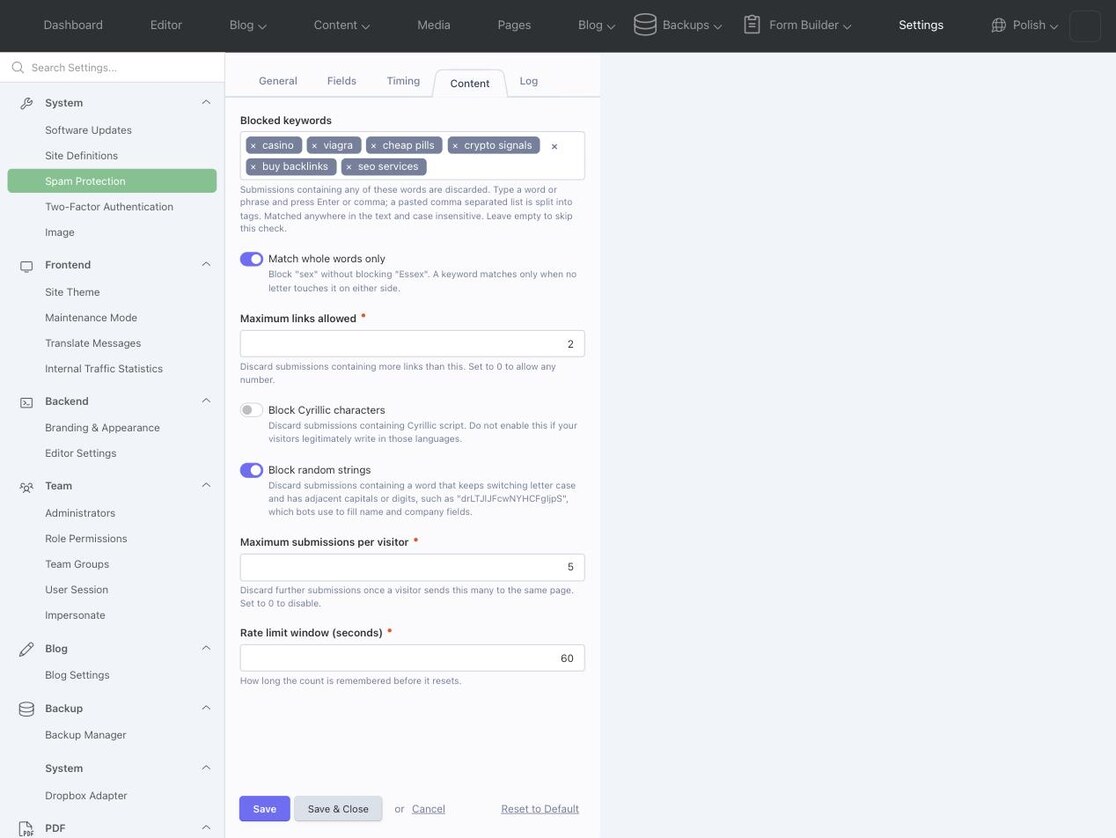
- Content rules — blocked keywords (substring or whole word), a cap on links, Cyrillic script and the machine-generated strings bots type into name and company fields
- Rate limiting per visitor and page, and a single-use form token that stops a harvested form from being replayed
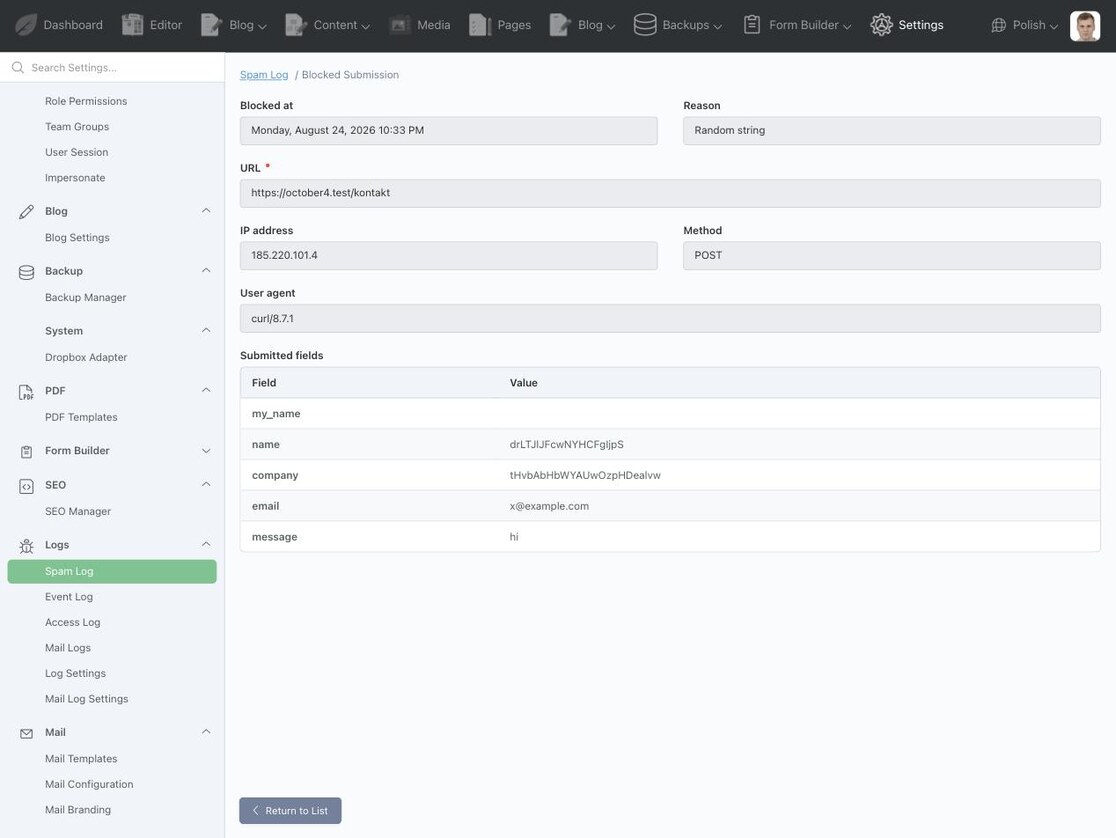
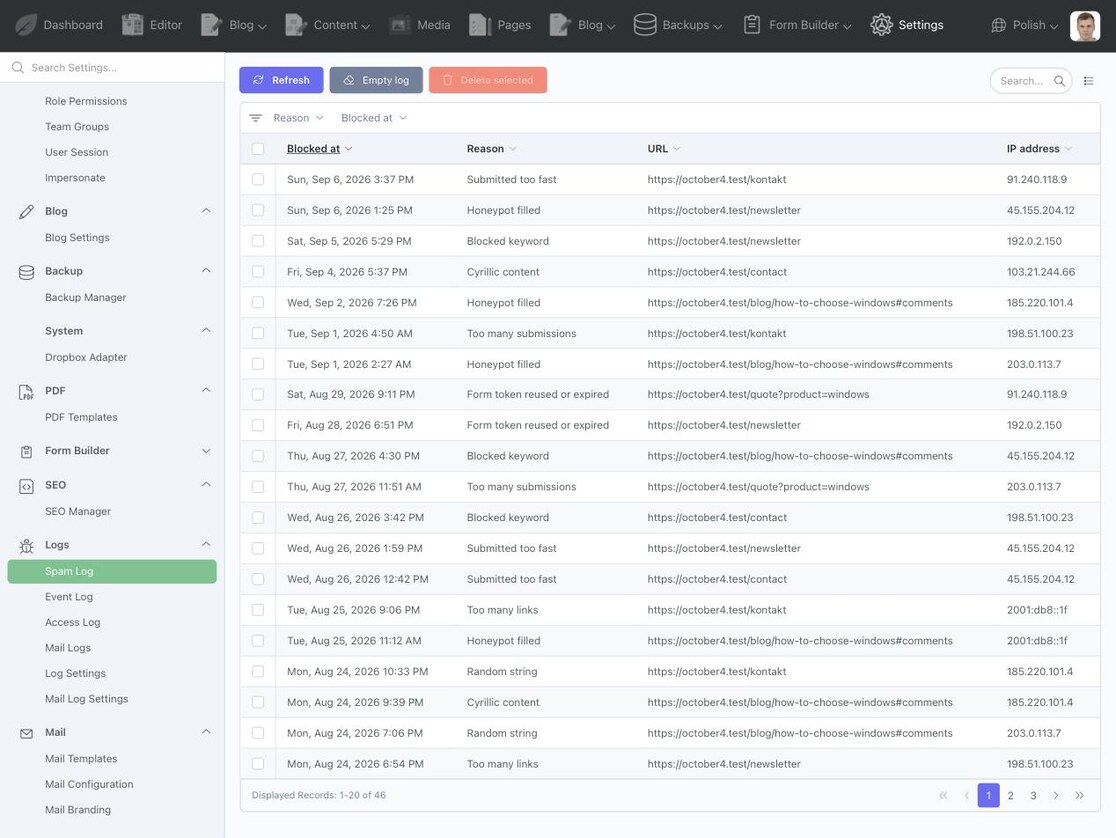
- Spam log — every blocked submission with its reason, address, browser and the submitted fields, sensitive values redacted, pruned on a schedule you choose
- Path exclusions for webhooks and endpoints that must never be inspected, and a CSP nonce for sites with a strict Content Security Policy
- Works with Form Builder and any form that posts through the CMS, including AJAX handlers
- Multilingual: English, Polish, German, French, Spanish, Brazilian Portuguese, Italian, Russian, Dutch and Czech translations included — more available on request
Requirements
This plugin requires PHP 8.2 or higher and October CMS 4.0 or higher. Running its test suite and static analysis needs PHP 8.4.
Why is this a paid plugin?
Something that is free has little or no perceived value. Users do not commit to free products and only use them until something else that looks nice and is free comes along. When I invest my time in the development of a new plugin I commit to supporting and maintaining it. I ask my customers to do the same. I do not make money from this plugin by advertisements, upgrades or additional services like hosting or setup.
Did you know that 30% of your purchase or donation goes to help fund the October Project?
My plugins take many hours to develop (40-120+) and even more hours to document and maintain. My paid plugins have to pay for both this time, and the time I am spending on free plugins and less successful paid plugins. This means that it will take even a successful plugin years to become profitable. Please consider buying an extended license if you want me to continue to maintain these plugins for the very small fee I ask in return or hire me for adding functionality that you feel is missing but valuable.
Like this plugin?
If you like this plugin, give this plugin a Like or Make donation with PayPal.
My other plugins
Please check my other plugins.
Support
Please use GitHub Issues Page to report any issues with plugin. Read the upgrade guide before updating.
Reviews should not be used for getting support or reporting bugs, if you need support please use the Plugin support link.
Icon made by Darius Dan from www.flaticon.com.
This plugin is also included into the following bundle


Installation via Command Line
php artisan plugin:install Renatio.SpamProtection
Documentation
Usage
After installing this plugin, all you need to do is to add the component to your form.
Add spamProtection component on frontend page or layout.
[spamProtection]
==
Then just place component tag anywhere inside your form tag.
<form>
    {% component 'spamProtection' %}
</form>
That's all you need to protect yourself from spam bots. Everything will work just like before, but when a spam bot fills the form, the form will not be sent.
Settings
Go to Settings -> System -> Spam Protection to configure the plugin.
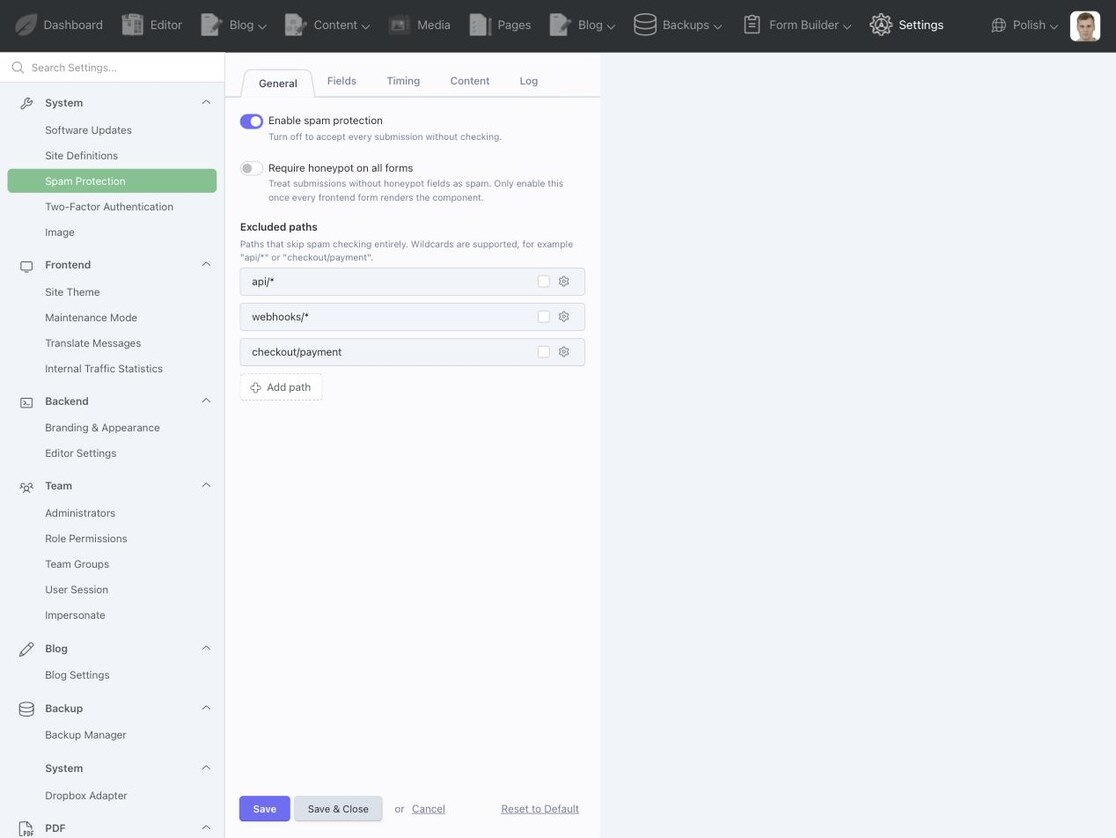
- General — turn protection on or off, and decide whether submissions without honeypot fields count as spam. Only enable the latter once every frontend form renders the component.
- Fields — the honeypot and timestamp field names. They must not collide with fields your forms actually use. Randomizing the honeypot name appends a random suffix on every render, which makes the field harder for bots to learn.
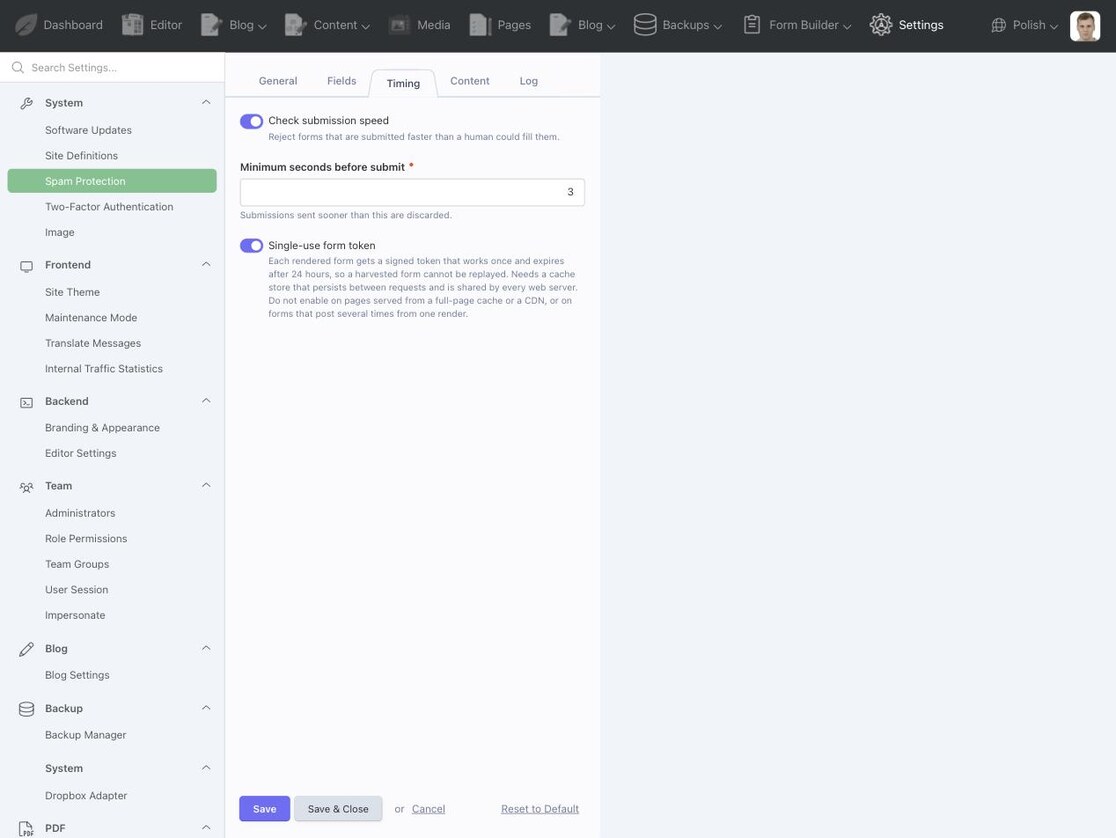
- Timing — reject forms submitted faster than a human could fill them, and how
many seconds that means. The single-use form token goes further: every
rendered form carries a signed token that is accepted once and expires after
24 hours, so a bot that harvested one form cannot keep resubmitting it. Like
the other checks it guards submissions that carry the honeypot fields. The
token is only spent when the submission gets through, so a validation error or
a honeypot rejection leaves the form usable. It needs a cache store that
persists between requests and is shared by every web server (
redis,database,memcached;fileonly on a single server); witharrayornullthe settings page refuses the switch, and should the store change later the token is ignored and a warning is logged. Leave it off on pages served from a full-page cache or a CDN, where every visitor would receive the same token. A form that posts several times from one render, such as a multi-step or "send another" form, has to refresh the token between posts, since only the first one gets through. - Content — discard submissions containing blocked keywords, more links than
you allow, Cyrillic script, or a random string such as
drLTJlJFcwNYHCFgIjpS(a word of ten or more letters that switches case at least three times and contains adjacent capitals or digits), and cap how many submissions one visitor may send in a time window. Every rule is off by default. - Log — whether blocked submissions are recorded, and for how long.
Paths listed under Excluded paths skip every check, which is the way to leave a
form or an endpoint unprotected. Add one path per row; wildcards such as api/*
are supported. The
honeypot middleware runs before a page is resolved, so exclusions are matched
against the request path rather than set on the page itself.
Refreshing the single-use token
A rendered form carries one token and the token is spent by the first submission
that gets through. When the form stays on the page and posts again, ask the
component for a fresh token first. The onRefreshSpamToken handler returns the
field name and a new token (or null while the setting is off). Call it with
jax.ajax, not from the form: an AJAX request that names the handler runs nothing
but that handler, so it is let through without any check even with the spent
token still in the form.
<form data-request="onSubmit" data-request-success="refreshSpamToken(this)">
    {% component 'spamProtection' %}
</form>

<script>
function refreshSpamToken(form) {
    jax.ajax('spamProtection::onRefreshSpamToken', {
        success: function (data) {
            var field = form.querySelector('[name="' + data.spamTokenField + '"]');
            if (field && data.spamToken) {
                field.value = data.spamToken;
            }
        }
    });
}
</script>
Call it the same way when a step of a multi-step form has been accepted. A submission that fails validation keeps its token, so nothing needs refreshing then.
Content Security Policy
If your site sends a Content Security Policy, hand the component the nonce of the
current response and it renders the hiding rule as a <style nonce="..."> block
instead of an inline style attribute, which a nonce cannot whitelist.
Component properties only accept {{ name }} references inside a partial, so
either pass the nonce as a partial variable:
{% partial 'contact-form' cspNonce=nonce %}
[spamProtection]
nonce = "{{ cspNonce }}"
==
<form>
    {% component 'spamProtection' %}
</form>
or set the property from the page life cycle, using whatever produces the nonce on your site:
function onInit()
{
    $this->spamProtection->setProperty('nonce', $nonce);
}
Leave the property empty when no policy is in place.
How the checks are applied
The middleware inspects every POST request handled by the CMS, including AJAX
handlers. All checks, the honeypot as well as the content rules and the rate
limit, only run on submissions that carry the component's fields, unless
Require honeypot on all forms is on. AJAX requests from pages without the
component are therefore left alone, and a bot that drops the fields entirely is
only caught once that setting is on.
The rate limit counts by client IP address. Behind a load balancer or a proxy such
as Cloudflare every visitor arrives from the proxy's address and shares one
counter, so the settings page shows a warning whenever the limit is on and the
request that opened it carries a forwarding header without coming from a
trusted proxy. Register the proxy in
app/Provider.php so Laravel reads the visitor address from the forwarded
headers, and only list addresses you control, since a trusted header can be
forged by anyone who can reach the server directly:
use Illuminate\Http\Request;

public function boot()
{
    parent::boot();

    Request::setTrustedProxies(
        ['10.0.0.0/8', '173.245.48.0/20'],
        Request::HEADER_X_FORWARDED_FOR | Request::HEADER_X_FORWARDED_PROTO
    );
}
The plugin does not read CF-Connecting-IP or similar headers itself, because a
bot that bypasses the CDN could set them to any address and dodge the limit.
Blocked keywords are matched as substrings anywhere in the text, so sex also
matches Essex. Turn on Match whole words only to require that no letter
touches the keyword on either side; this works with accented letters too, so
gęś no longer matches gęślą. Keywords are entered as tags, so a keyword may
contain spaces but not a comma.
The content rules read every submitted text field, nested ones included, except
the honeypot fields, the CSRF token and the fields whose values are
machine-generated by design: captcha responses (g-recaptcha-response,
h-captcha-response, cf-turnstile-response, frc-captcha-*), anything named
password and the ad click identifiers gclid, fbclid and msclkid.
Requests handled outside the CMS controller, such as plugin routes, are not covered.
Spam log
Every blocked submission is recorded under Settings -> Logs -> Spam Log, together
with the reason it was blocked, the originating IP address and the submitted
fields. Values that look sensitive (passwords, tokens, card numbers) are replaced
with [redacted] before anything is written, and the CSRF token is dropped
entirely. Values longer than 255 characters are cut. A failure to write the log
is reported to the application log and never affects the response.
Entries older than the configured retention window are removed by the daily schedule, so make sure the October scheduler is running:
* * * * * php /path/to/artisan schedule:run >> /dev/null 2>&1
Reasons
| Reason | Meaning |
|---|---|
honeypot_filled |
The hidden honeypot field carried a value. |
submitted_too_fast |
The timestamp field was sent before it became valid, or it was tampered with. |
missing_fields |
The form carried no honeypot fields while Require honeypot on all forms is on. |
blocked_keyword |
A blocked keyword was found in the submitted text. |
too_many_links |
More links than Maximum links allowed. |
cyrillic_content |
Cyrillic script found while Block Cyrillic characters is on. |
random_string |
A word switching letter case repeatedly, with adjacent capitals or digits, while Block random strings is on. |
token_missing |
The form carried no single-use token while Single-use form token is on. |
token_reused |
The single-use token was already spent or is older than 24 hours. |
rate_limited |
The visitor exceeded Maximum submissions per visitor on that page. |
Personal data
The log stores the visitor's IP address, user agent and the submitted fields, which
may contain personal data of a real person caught by a rule by mistake. Keep the
retention window as short as your review process allows, restrict the
View blocked spam log permission, or turn logging off entirely. Use
Empty log on the log page to delete everything at once.
Excluding an endpoint
Every POST handled by the CMS goes through the middleware, including your own
AJAX handlers and pages that receive webhooks. When such an endpoint must not be
inspected, add its path under Excluded paths, for example webhooks/* or
checkout/payment.
Using with Form Builder
The Form Builder plugin adds the component to every form it renders, so no theme changes are needed. Both can be combined with reCAPTCHA: the honeypot discards bots before the form is even validated, and reCAPTCHA covers what slips through.
Using with existing form component
When you have your custom component form and want to add Spam protection component all you need to do is add it in your component init() function.
use Renatio\SpamProtection\Components\SpamProtection;

public function init()
{
    $this->addComponent(SpamProtection::class, 'spamProtection', []);
}
Then add it to your view component:
<form>
    {% component 'spamProtection' %}
</form>
-

Wachem Huyge
Found the plugin useful on 7 Sep, 2024
Works like a charm.
-

Renatio author
Replied on 11 Sep, 2026
Thanks, Wachem — glad it's working like a charm! Sorry for the late reply.
A lot has been added since your review: content rules that block submissions by keywords and links, and a log of every blocked submission, so you can see what was stopped and why. If you haven't updated in a while, it's worth a look.
If you run into anything or have an idea for the plugin, please open an issue on the GitHub Issues page.
-


| 2.1.1 |
Add the onRefreshSpamToken component handler that hands a form a fresh single-use token without a reload. Sep 09, 2026 |
|---|---|
| 2.1.0 |
Move the settings to the backend and log every blocked submission with its reason and fields. Sep 09, 2026 |
| 2.0.3 |
Update dependencies. Jul 12, 2025 |
| 2.0.2 |
Update dependencies. Jul 07, 2025 |
| 2.0.1 |
Require October 4. Jun 30, 2025 |
| 1.0.2 |
Fix Twig security policy error. Nov 22, 2022 |
| 1.0.1 |
First version of Spam Protection plugin. Nov 17, 2022 |
Upgrade guide
Versions not listed here need no action. Back up the database before upgrading.
Upgrading To 2.0.1
Plugin requires October CMS 4.0 or higher.
Upgrading To 2.1.0
Plugin requires PHP 8.2 or higher. Run php artisan october:migrate to create the spam log table.
Settings moved from config/config.php to Settings → System → Spam Protection; the config file now only seeds
the defaults. Blocked submissions are recorded under Settings → Logs → Spam Log and pruned daily, so make sure
the scheduler runs. Two new permissions, Manage spam protection settings and View blocked spam log, gate the
pages. Content rules, rate limiting, path exclusions and the single-use form token are off by default; the token
needs a cache store that persists between requests.