

SEO Manager
Meta tags, Open Graph, JSON-LD, hreflang and XML sitemaps for October CMS — ready for Google and AI search.
SEO Manager
Meta tags, Open Graph, JSON-LD, hreflang and XML sitemaps for October CMS — ready for Google and AI search.

Renatio SEO Manager Plugin
Meta tags, Open Graph, JSON-LD, hreflang and XML sitemaps for October CMS — ready for Google and AI search.
Demo URL: https://october-demo.renatio.com/backend/backend/auth/signin
Login: seomanager
Password: seomanager
Supports CMS Pages, RainLab.Pages, RainLab.Blog and October CMS Tailor out of the box, and attaches to any October CMS model with one line of code.
Features
- SEO and Open Graph tabs for CMS pages, RainLab.Pages, RainLab.Blog, Tailor entries and any model
- Import of existing SEO values from CMS pages, static pages and blog posts
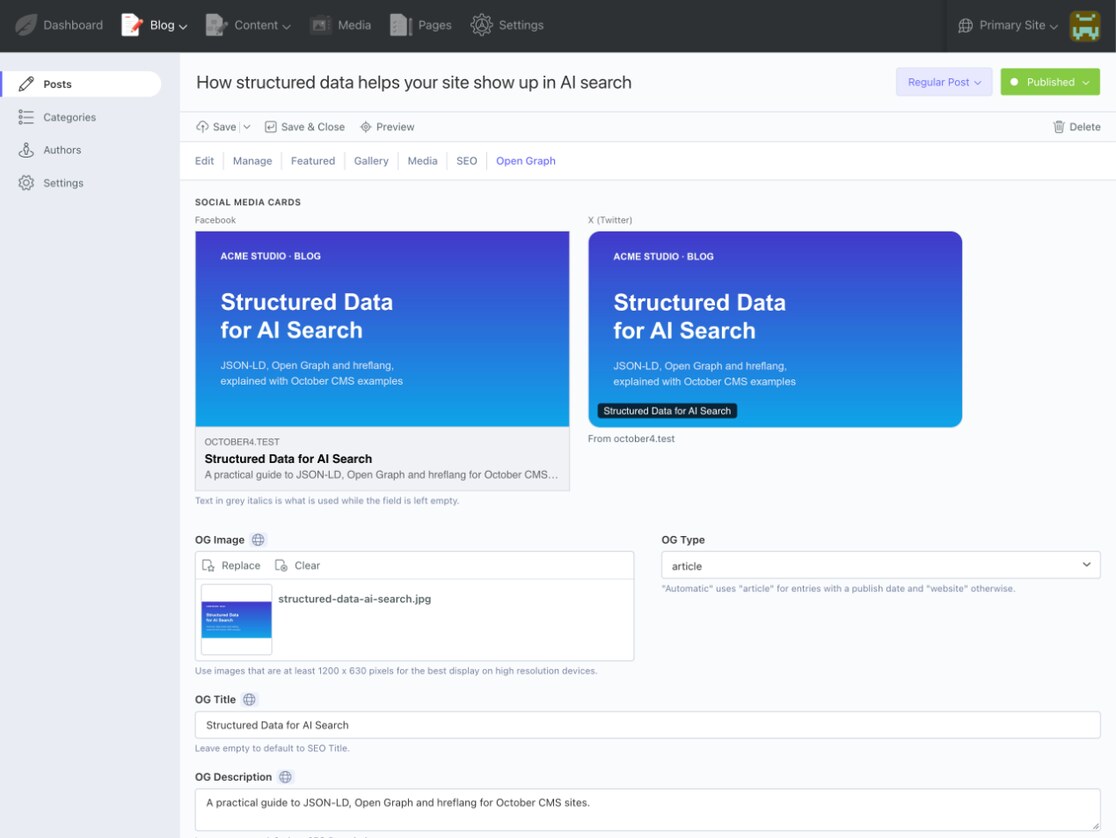
- Live Google snippet and Facebook / X share card previews in the backend forms
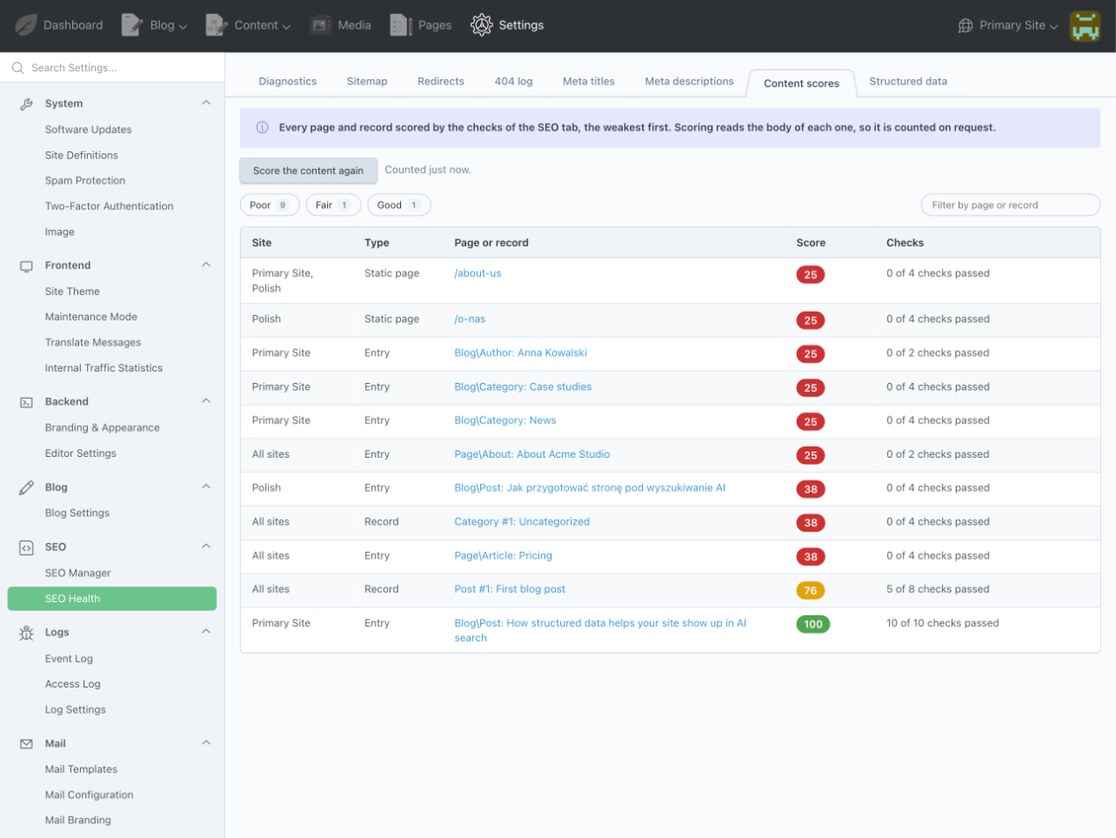
- Content analysis with a focus keyword, a checklist and a 0-100 score, per record and for the whole site
- Robots meta, canonical URLs and 301 redirects, including automatic redirects for renamed records
- A 404 log with the closest existing page for each missing address
- JSON-LD: Organization or LocalBusiness, WebSite, BreadcrumbList, Article/BlogPosting, and FAQPage, Product and Event mapped from Tailor fields
- Social profile links with brand icons, from the same data the structured data uses
- Hreflang tags and an XML sitemap with alternates for multisite
- llms.txt and llms-full.txt for language models and agents
- IndexNow submissions to Bing, Yandex, Seznam and Naver
- SEO Health page, dashboard widget and
seo:doctorreporting misconfigurations that fail silently - robots.txt editor with an AI crawler policy, and an optional .htaccess editor
- October's native multisite and translations; RainLab.Translate is still read as legacy
- Backend in English, Czech, Dutch, French, German, Italian, Polish, Brazilian Portuguese, Russian and Spanish
Requirements
- October CMS 4.4 or newer
- PHP 8.2 or newer, with the
domandxmlextensions spatie/laravel-sitemap7.2+ or 8.0.1+ (8.x needs PHP 8.4) andleague/html-to-markdown5.1+, installed by Composer
Why is this a paid plugin?
Something that is free has little or no perceived value. Users do not commit to free products and only use them until something else that looks nice and is free comes along. When I invest my time in the development of a new plugin I commit to supporting and maintaining it. I ask my customers to do the same. I do not make money from this plugin by advertisements, upgrades or additional services like hosting or setup.
Did you know that 30% of your purchase or donation goes to help fund the October Project?
My plugins take many hours to develop (40-120+) and even more hours to document and maintain. My paid plugins have to pay for both this time, and the time I am spending on free plugins and less successful paid plugins. This means that it will take even a successful plugin years to become profitable. Please consider buying an extended license if you want me to continue to maintain these plugins for the very small fee I ask in return or hire me for adding functionality that you feel is missing but valuable.
Like this plugin?
If you like this plugin, give this plugin a Like or Make donation with PayPal.
My other plugins
Please check my other plugins.
Support
Please use GitHub Issues Page to report any issues with plugin.
Reviews should not be used for getting support, if you need support please use the Plugin support link.
Icon made by Darius Dan from www.flaticon.com.
This plugin is also included in the following app


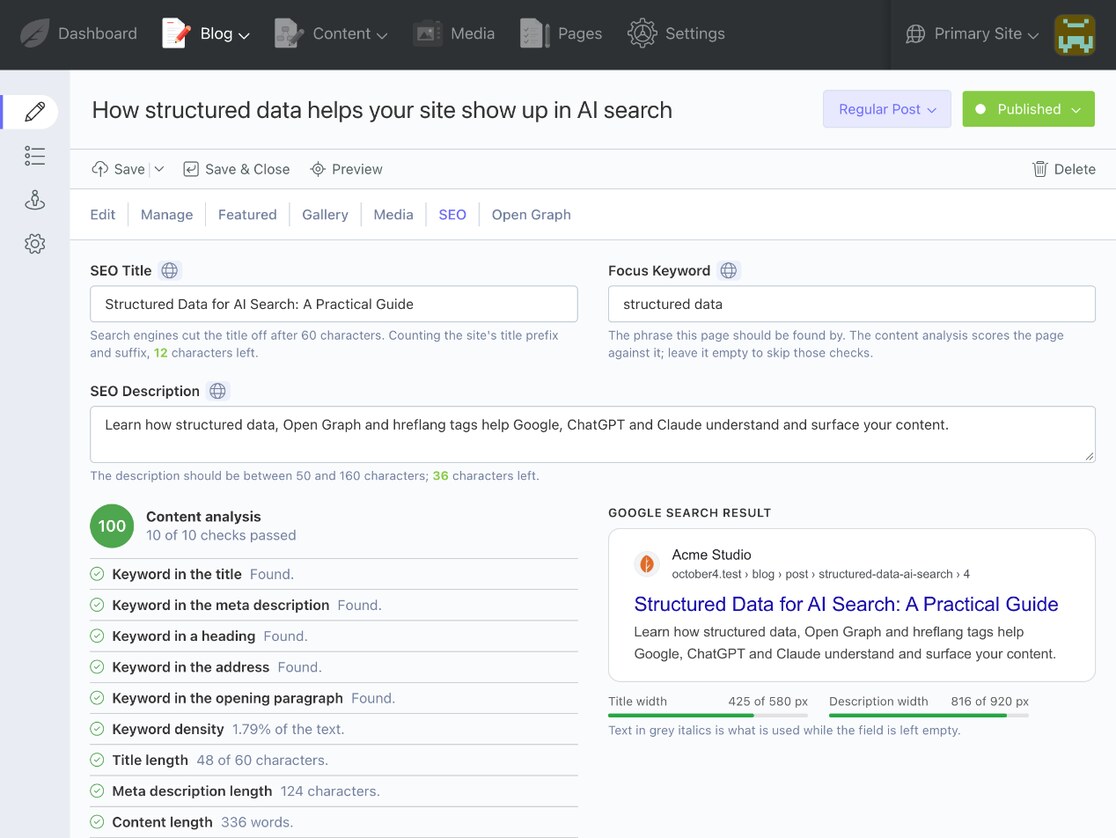
SEO tab with focus keyword, live content analysis score and Google search result preview.
Installation via Command Line
php artisan plugin:install Renatio.SeoManager
Documentation
Usage
CMS pages, static pages, blog posts and categories get SEO and Open Graph tabs after installation (on RainLab.Pages 3
they are tabs of the static page Settings popup). Place the seoTags component in the head of your layout:
[seoTags]
==
<!DOCTYPE html>
<html>
    <head>
        {% component 'seoTags' %}
    </head>
To prefill the SEO fields from what the pages already hold, run seo:import-cms, seo:import-static or
seo:import-blog.
Where the tags come from
A page that renders a Tailor entry with the SEO mixins, or a model with the SeoModel behavior, takes its tags from
that record; any other page uses its own SEO tab.
- A blank field of the record falls back to the same field of the CMS page, except the canonical URL, the 301 redirect,
og:typeand the focus keyword. A blank SEO Title falls back to the record'stitleorname. - The record is the one the address names: first the one a component looks up by a URL parameter (
blogPostorsectionbound to:slug), then a page variable holding a parameter's value (:slugand itsslug), then the record a component shows on its own. Only a page without URL parameters takes the first record with SEO fields among its variables, so a featured post in a sidebar never takes over the page. - The hreflang links describe the same record, and the sitemap applies the same
noindexfallback.
Behind a CDN, a reverse proxy or a full-page cache set LINK_POLICY=force in .env. With the default detect October
builds the canonical, og:url and hreflang addresses from the host of the request, which an X-Forwarded-Host header
can change.
October CMS Tailor
Add the two mixins to the fields of a blueprint, then run php artisan tailor:migrate:
_seo_meta_fields:
    type: mixin
    source: Renatio\SeoManager\MetaFields

_seo_og_fields:
    type: mixin
    source: Renatio\SeoManager\OgFields
Run tailor:migrate after every plugin update that changes the mixins: october:migrate does not touch Tailor
tables, and saving an entry fails with Unknown column until it runs. The Tailor blueprint columns check on SEO
Health names the tables that are behind and runs the migration from a button.
Your own models
Add the behavior to the model:
public $implement = ['@Renatio.SeoManager.Behaviors.SeoModel'];
The next php artisan october:migrate adds the SEO columns to its table (failures go to the log, not the console). To
add them right away, or when add_seo_columns is false in config/renatio/seomanager/migrate.php:
php artisan seo:migrate-tables --force
Without the columns nothing entered in the SEO tab is stored; the SEO columns check on SEO Health names such tables and adds the columns from a button.
Publish the record to the page, with an attribute matching a URL parameter (/albums/:slug and the album's slug):
public function onRun()
{
    $this->page['album'] = Album::where('slug', $this->param('slug'))->first();
}
Or assign it yourself before the component renders:
Event::listen('seo.beforeComponentRender', function ($component, $page) {
    if ($page->url === '/products/:slug') {
        $component->seoTag = $page->controller->vars['product'];
    }
});
$component->seoTag is a copy of the record: changes made to it never reach the database. Titles and descriptions are
escaped, nothing else is, so assign only content you would put on the page yourself.
Settings
Settings > SEO > SEO Manager:
| Tab | Holds |
|---|---|
| General | site name, Language and region (multisite only, e.g. de-CH), Default language version (x-default), title prefix and suffix, Common meta tags, Allowed redirect hosts, Redirect renamed records, 404 log and Keep entries for, Live content analysis |
| Open Graph | the switch, Facebook Application ID, Twitter/X site handle, default image |
| Organization | the JSON-LD switch, Schema.org identity (Organization or a LocalBusiness type), logo, contact data, address, founding date, coordinates and opening hours |
| Social profiles | one row per profile: Address, Service (picks the icon), optional Name |
| Sitemap | the switch, Rebuild frequency and hour, Excluded paths, the IndexNow section |
| llms.txt | the llms.txt and llms-full.txt switches, summary, links, Add the pages of the sitemap |
| robots.txt | the editor and the AI crawler policy |
| .htaccess | the switch and the editor, only where the server reads .htaccess |
Fields with a fixed format (locale, country, X handle, Facebook ID, telephone, prefix and suffix) are validated, and the
country code and handle are normalized (pl → PL, acme → @acme). robots.txt is read from and written to the
web root (public once it holds index.php, otherwise a file in the project root is kept); .htaccess keeps a project
root file while public has none. Neither is ever overwritten with empty content.
Common meta tags are output unescaped on every page, so they can carry scripts. They need their own permission.
Multisite
Each site has its own settings: pick it in the backend site switcher. A site never saved reads the settings of its site group, and Reset to default returns it to them rather than to the plugin defaults. Its locale is the exception: a new site reports its own October locale until a region is set.
Shared by the whole installation, and labelled as such: robots.txt with the AI crawler policy, .htaccess and its switch, the allowed redirect hosts, x-default, the sitemap rebuild schedule, the 404 log retention and the IndexNow key.
The .htaccess tab
The tab appears where SERVER_SOFTWARE names Apache or LiteSpeed, and editing stays off until switched on there.
With cms.safe_mode on the editor is read-only and the panel never writes the file.
Decide it yourself in config/renatio/seomanager/htaccess.php:
return [
    'tab' => true, // or false; null detects the server
];
Permissions
| Permission | Guards | Default roles |
|---|---|---|
| Manage SEO settings | the settings page, every field not listed below, Generate a new key | Developer, Publisher |
| View SEO Health and run its checks | SEO Health, its widget, sitemap rebuild, deleting rename redirects and 404 entries | Developer, Publisher |
| Change robots.txt and the AI crawler policy | the robots.txt editor, its reset and the AI crawler policy | Developer |
| Change the allowed redirect hosts | the external hosts a 301 may point to | Developer |
| Change common meta tags | the raw HTML in the head of every page | Developer |
| Change the .htaccess file | the .htaccess switch and editor | Developer |
| Add the missing SEO columns | the SEO Health buttons that alter other plugins' tables and run tailor:migrate |
Developer |
| Delete the static sitemap file | the SEO Health button that deletes a file from the web root | Developer |
A field the user lacks the permission for is left out of the form. October locks its built-in roles, so give a Developer-only permission to an editor through a custom role in Settings > Administrators > Roles.
SEO fields
| Field | Notes |
|---|---|
| SEO Title | the document title; prefix and suffix from the settings are added |
| SEO Description | the snippet in search results |
| Focus Keyword | the phrase the content analysis checks for |
| Meta Robots | index / follow switches; Meta Robots Advanced takes other directives, e.g. noarchive, max-snippet:150 (not all or none) |
| Canonical URL | a path from the root or an absolute http(s) URL |
| Meta Keywords | ignored by Google and Bing, kept last |
| 301 Redirect | a relative path or an absolute URL on a site host or an allowed redirect host |
On a CMS page, October's own Meta section fills whatever the SEO popup leaves blank. The 301 redirect needs the
seoTags component on the page or its layout; it is skipped when it points at the current URL, loops back through a
rename redirect, or on error pages. A non-GET request to a target on a site host is redirected with 308, so its body
survives.
The canonical tag names the record's own address (a Tailor entry or blog post at /notes/01 is canonical /notes/1)
and drops the query string except the page number of a paginated listing: the parameters in query_params of
config/renatio/seomanager/canonical.php (default page), kept as positive integers, with page 1 named without it. The JSON-LD page
address follows it; breadcrumbs keep the path only. A canonical naming another address takes the page out of the
sitemap, llms.txt and IndexNow, while SEO Health still audits it; a record kept per site (a Tailor entry, a blog post
per site) also leaves the hreflang set of its translations.
Error responses
- Any status of 400 or above gets
noindex, nofollow, except 503 (maintenance mode). - The theme's
404anderrorpages and any 404 or 410 also drop the canonical (unless one is filled in), the alternates, the Open Graph and Twitter tags, and theBreadcrumbListandArticleschemas.
Open Graph
OG Title, OG Description, OG Type and OG Image fall back to the SEO title, the SEO description, an
automatic type (article for a record with a publish date, website otherwise) and the record's own image. Add a type:
Event::listen('seo.extendOgTypes', function (array &$types) {
    $types[] = 'music.playlist';
});
Locale. og:locale comes from the active site and og:locale:alternate from the other sites of its group. A bare
language gets its usual territory (de → de_DE, pt-br → pt_BR). Two sites serving one language to two countries
set Language and region (de-DE, de-CH), which also drives hreflang. Change the map in
config/renatio/seomanager/og_locales.php (only the keys you change) or per language:
Event::listen('seo.extendOgLocales', function (array &$locales) {
    $locales['de'] = 'de_AT';
});
Image. Without an OG Image the record's own image is used, then the default image from the settings. The
attributes or attachOne / attachMany relations banner, featured_images, image, images, photo, photos,
cover and thumbnail are tried in order, then every other attachment the model declares. Only public jpg, jpeg,
png, gif, webp and avif files count; width and height are known only for Media Library images. Set sources or
'search_attachments' => false in config/renatio/seomanager/record_image.php, or add a name per model:
Event::listen('seo.extendImageSources', function (array &$sources, Model $model) {
    if ($model instanceof Album) {
        $sources[] = 'cover_photo';
    }
});
Backend preview
The SEO tab opens with the Google result, the Open Graph tab with the Facebook and X cards, redrawn as you type. An
empty field shows in grey what the page would use instead. Title and description are measured in pixels (580 and 920,
a desktop result). The address follows the page that serves the record and the Slug field; the favicon comes from
the theme's assets/images/favicon.*, assets/img/favicon.*, assets/favicon.* or the web root.
The preview cannot show what a blank field inherits from the CMS page, and an unsaved record shows the default image.
Content analysis
Every SEO tab carries a Content analysis panel scoring the form as it stands. It refreshes as you type; with Live content analysis off it shows an Analyze again button instead. CMS pages get the Focus Keyword field but no panel. Keyword checks are skipped without a keyword; the keyword is matched ignoring case and accents but not stemmed.
| Check | Passes when |
|---|---|
| Keyword in the title / meta description / a heading / the address / the opening paragraph | it is found there (prefix and suffix count; hyphens in the slug read as spaces) |
| Keyword density | 0.5-2.5 % of the words; skipped under 100 words |
| Title length | 30-60 characters |
| Meta description length | 50-160 characters |
| Content length | at least 300 words |
| Heading structure | at most one H1 and no skipped level (a missing H1 passes) |
| Image alt text | every image has alt text |
The score is the share of the applicable checks' weight: Good from 80, Fair from 50, Poor below. An empty body fails Content length and warns on Heading structure; a record whose body field cannot be found is skipped with a hint.
Where the body comes from
-
the posted form;
-
the
seoContentkey of the Tailor blueprint:handle: Blog\Article type: entry seoContent: [lead, body]
-
sourcesinconfig/renatio/seomanager/content_text.php(defaultmarkup,content_html,content,body_html,body,text,description,intro,excerpt); -
the
seo.resolveContentTextevent, fired on every record with what the steps above found:Event::listen('seo.resolveContentText', function (string &$text, mixed $record, array $posted) { if ($record instanceof Album) { $text = $record->notes; } });
Custom checks
use Renatio\SeoManager\Classes\Analysis\Check;
use Renatio\SeoManager\Classes\Analysis\Content;
use Renatio\SeoManager\Classes\Analysis\Result;

class PlaceholderText extends Check
{
    public function key(): string
    {
        return 'acme_placeholder';
    }

    public function run(Content $content): Result
    {
        if ($content->document()->isEmpty()) {
            return $this->skip('no_content');
        }

        return str_contains(mb_strtolower($content->document()->text()), 'lorem ipsum')
            ? $this->problem('found_text')
            : $this->ok();
    }
}

Event::listen('seo.extendAnalysisChecks', function (array &$checks) {
    $checks[] = new PlaceholderText; // an instance, not a class name
});
A check returns ok(), warning(), problem() or skip() and may override weight() (1). A check that throws is
dropped. Labels come from app/lang/renatio/seomanager/<locale>/lang.php, which October merges over the plugin's:
return [
    'analysis' => [
        'acme_placeholder' => 'No placeholder text',
        'acme_placeholder_ok' => 'The content holds no lorem ipsum.',
        'acme_placeholder_found_text' => 'The content still holds lorem ipsum.',
    ],
];
JSON-LD structured data
seoTags outputs <script type="application/ld+json"> blocks; switch them on the Organization settings tab, which
also warns about missing data. The Structured data tab of SEO Health previews the output for any address and links
to the Schema.org validator and the Rich Results Test.
| Schema | Output |
|---|---|
| Organization | when the site name is set; a LocalBusiness type adds coordinates and opening hours; empty fields are left out |
| WebSite | when the site name is set |
| BreadcrumbList | every page but the home page, from the URL path; intermediate levels only where a CMS page serves them |
| Article / BlogPosting | records with title and published_at; Tailor entries and blog posts are BlogPosting |
| FAQPage, Product, Event | mapped from Tailor fields, see below |
| Article property | Resolution order |
|---|---|
| headline | meta_title → title (max 110 chars) |
| description | meta_description → excerpt → content (first 200 chars), as plain text |
| image | og_image → the record image (see Open Graph) |
| author | user relation (full name) → author string → author relation |
| publisher | the Organization, with name, URL and logo |
| mainEntityOfPage | Canonical URL → page address |
| datePublished / dateModified | published_at / updated_at → published_at |
Schemas from Tailor fields
Map entry fields under seoSchema in the blueprint. A value names a field, field.attribute reaches through a
relation, = starts a constant; items names a repeater:
handle: Shop\Product
type: entry
seoSchema:
    -
        type: Product
        name: title
        description: intro
        image: photo
        sku: sku
        brand: brand_name
        offers:
            price: price
            priceCurrency: =PLN
            availability: stock_status
        aggregateRating:
            ratingValue: rating
            reviewCount: reviews_count
    -
        type: FAQPage
        items: faq_items
        question: question
        answer: answer
| Type | Written only when it has |
|---|---|
FAQPage |
at least one item with a question and an answer |
Product |
name and offers or aggregateRating; an offer needs a numeric price and a priceCurrency |
Event |
name, startDate and a location (an address or a stream URL) |
Dates are written as ISO 8601, availability only as Schema.org values (InStock, OutOfStock, ...), a decimal comma
is converted. Google shows FAQ rich results only for government and health sites. The Schemas from Tailor fields
check on SEO Health reports unknown types, missing required properties and unknown fields.
Map records without a blueprint, or add any schema:
Event::listen('seo.extendSchemaMapping', function (array &$mappings, mixed $record) {
    if ($record instanceof Post) {
        $mappings[] = ['type' => 'FAQPage', 'items' => 'faqs', 'question' => 'question', 'answer' => 'answer'];
    }
});

Event::listen('seo.extendJsonLd', function (array &$schemas, mixed $seoTag, Settings $settings, bool $missing) {
    $schemas[] = ['@context' => 'https://schema.org', '@type' => 'Event', /* ... */];
});
Social profiles
The Social profiles tab feeds sameAs of the Organization schema and the socialProfiles component, each site its
own:
[socialProfiles]
only = "facebook,instagram"
==
{% component 'socialProfiles' %}
| Property | Default | Description |
|---|---|---|
only |
only these services, comma separated | |
except |
leave these services out | |
target |
_blank |
link target; empty opens in the same tab |
class |
social-profiles |
class of the list and stem of the element classes |
iconSize |
24 |
icon width and height in pixels |
iconClass |
an icon font instead of the SVG; fab fa-:icon renders fab fa-facebook |
Links carry an inline SVG brand icon and an aria-label. To change the markup, copy the partial to
themes/<theme>/partials/socialProfiles/default.htm; each profile has url, icon, name, path and viewBox:
{% for profile in __SELF__.profiles %}
    <a href="{{ profile.url }}" aria-label="{{ profile.name }}">
        <svg viewBox="{{ profile.viewBox }}" width="20" height="20" aria-hidden="true">
            <path d="{{ profile.path }}"/>
        </svg>
    </a>
{% endfor %}
Add icons, or profiles kept elsewhere (url and icon are enough):
Event::listen('seo.extendSocialIcons', function (array &$icons) {
    $icons['goldenline'] = ['name' => 'GoldenLine', 'viewBox' => '0 0 24 24', 'path' => 'M12 0C5.4 0 ...'];
});

Event::listen('seo.extendSocialProfiles', function (array &$profiles, Settings $settings) {
    $profiles[] = ['url' => 'https://www.youtube.com/@acme', 'icon' => 'youtube'];
});
Icons: Simple Icons (CC0); LinkedIn and the globe from Bootstrap Icons (MIT).
Hreflang tags
With multisite and two or more sites in a set,
seoTags outputs <link rel="alternate" hreflang="…"> for each site plus x-default, which points to the primary site
unless Default language version (x-default) on the General tab names another. The links carry no query string
beyond the page number, like canonical and og:url.
A record is linked under each site's own version of it: Tailor entries, blog posts kept per site, and records of any
model with October's Multisite trait sharing a site_root_id. A site without a version, or one set to noindex, gets
no link. The sitemap alternates use the same sets.
Which sites form a set:
- Sites running one theme join across groups, unless a language is claimed in two of their groups (two brands on
one theme, or
deon a German and a Swiss domain); then each group keeps its own set. Set a region (de-DE,de-CH) to join them. - Groups are all or nothing. Without any groups every enabled site is linked; once one site has a group, a site alone in its group or without one is linked only to sites running its theme.
- Every site needs its own language. Sites claiming the same language drop out of the set; SEO Health names the language on its Sitemap tab.
Narrow the sites (keep the result reciprocal), or edit the links of a page (a set left with fewer than two links is dropped):
Event::listen('seo.alternateSites', function (SiteCollection &$sites) {
    $sites = $sites->inSiteGroup();
});

Event::listen('seo.extendHreflang', function (array &$links, Controller $controller) {
    $links[] = ['locale' => 'fr', 'url' => 'https://example.com/fr/page'];
});
XML sitemap
Enable it on the Sitemap settings tab to serve /sitemap.xml per site (under its route prefix), with xhtml:link
alternates and a stylesheet at /sitemap.xsl. It lists CMS pages, static pages, blog posts and categories, Tailor
entries on a page with a section component (the Default View page wins), and records of any plugin on a page with
URL parameters. lastmod comes from updated_at, and addresses of a site without its own URL are built on APP_URL.
Left out: hidden pages, noindex, records with a 301 redirect, /404, /error, and the Excluded paths: one
pattern per line, without a host or query string, * for any part, matched without the route prefix:
/api/*
/search
/feed
When every layout of the theme carries seoTags (a subclass registered under another code counts), a CMS page with no
layout and no seoTags of its own (a feed, an export, a JSON endpoint) is left out of the sitemap, llms.txt, IndexNow
and the SEO Health audit, along with the Tailor entries and blog records it renders. A theme with a layout lacking the
component, or with the component in a partial, keeps every page.
A map over 50 000 URLs or 50 MB is split into sitemap-1.xml, sitemap-2.xml, … behind an index at /sitemap.xml.
With the sitemap off, /sitemap.xml is left to the CMS, so a theme page can serve it.
Rebuilding
The map is cached in storage/app/seomanager and rebuilt:
-
by the scheduler at the Rebuild frequency (every hour, every day or Sunday at the chosen hour in
app.schedule_timezone, or never; default daily at 03:00) — this needs October's cron entry:* * * * * php /path/to/artisan schedule:run >> /dev/null 2>&1
-
by the Rebuild sitemap button on SEO Health, through the queue (inline on
syncandnull); -
by the first request for a map older than 48 hours (two weeks with a weekly rebuild).
Other requests wait up to ten seconds and get the previous map, or a 503 with Retry-After on a cold cache. A site
whose map fails keeps its previous one and is logged; seo:sitemap lists it and exits with a failure. Give the queue
connection a retry_after longer than a full rebuild. Maps and llms documents answer If-Modified-Since with 304.
php artisan seo:sitemap          # rebuild every enabled site
php artisan seo:sitemap --clear  # clear the cache
Pages with URL parameters
A page such as /products/:slug is filled from October's page finder (the cms.pageLookup events behind a menu
item's Page field), so any plugin implementing it is listed. Plugins answering only RainLab.Pages'
pages.menuitem events should listen to both:
Event::listen(['cms.pageLookup.getTypeInfo', 'pages.menuitem.getTypeInfo'], ...);
Records read this way are listed even when set to noindex. A page no type can list is reported on SEO Health; set
it to noindex if it does not belong in the map.
Extending the sitemap
use Spatie\Sitemap\Sitemap;
use Spatie\Sitemap\Tags\Url;

Event::listen('seo.extendSitemap', function (Sitemap &$sitemap) {
    foreach (Product::where('is_published', true)->get() as $product) {
        $sitemap->add(Url::create(Cms::pageUrl('product/show', ['slug' => $product->slug]))
            ->setLastModificationDate($product->updated_at));
    }
});

// Read blog posts through your own Post subclass (e.g. one with the Multisite trait)
Event::listen('seo.blogPostModel', fn () => \Acme\Blog\Models\Post::class);
Add the address as a DescribedUrl to give llms.txt and llms-full.txt its title, description and body (Markdown,
read only when llms-full.txt is written). A plain Url is listed by its address alone.
use Renatio\SeoManager\Classes\DescribedUrl;

$sitemap->add(DescribedUrl::create($url)->describe($product->name, $product->summary, fn () => $product->description));
llms.txt and llms-full.txt
Enable them on the llms.txt settings tab. /llms.txt (llmstxt.org) is built from the site
name, the Summary and the Links (rows sharing a section are grouped; a URL starting with / gets the site's
prefix). Add the pages of the sitemap appends up to 500 sitemap addresses under ## Pages, newest first.
# Acme Studio

> Acme Studio designs and builds furniture for public spaces.

## Docs

- [Pricing](https://acme.test/pricing): What it costs
/llms-full.txt writes out the text of the same 500 pages:
## Steel heads

Source: https://acme.test/products/steel-heads

Forged, not cast.
A Tailor entry publishes only the fields marked llms: true in its blueprint (or its groups:), of type markdown,
textarea, text or richeditor; other pages without readable body (CMS pages, static pages, page finder records)
get their heading, address and description, in the language of each site. Blog posts are published in full.
fields:
    content:
        type: richeditor
        llms: true
    internal_notes:
        type: markdown
Both are cached and rebuilt like the sitemap, on its Rebuild frequency, with the Rebuild llms.txt button or
seo:llms. An expired document is served while a worker rebuilds it; saving the settings expires the site's documents.
Remove any static llms.txt or llms-full.txt from the web root (the Static llms.txt file check finds them).
Event::listen('seo.extendLlmsTxt', function (array &$sections) {
    $sections[] = ['name' => 'Products', 'links' => [
        ['title' => 'Hammer', 'url' => 'https://acme.test/hammer', 'description' => 'Forged steel'],
    ]];
});

Event::listen('seo.extendLlmsContent', function (string|false &$content, array $descriptor) {
    if (str_starts_with($descriptor['url'], 'https://acme.test/internal/')) {
        $content = false; // leaves the page out of llms-full.txt
    }
});
$descriptor holds url, title, description and lastmod.
IndexNow
Tells Bing, Yandex, Seznam and Naver (not Google) that an address changed, through api.indexnow.org. Turn it on per
site in the IndexNow section of the Sitemap tab. Saving generates one key shared by all sites, served at
/{key}.txt; Generate a new key replaces it everywhere and invalidates the old one.
php artisan seo:indexnow https://example.com/page   # one address
php artisan seo:indexnow --all                      # every sitemap address of every site with IndexNow on
Submit on save announces Tailor entries, blog posts and categories, CMS pages and static pages saved outside the
console, by the sitemap rules, including the old address after a slug change and records just unpublished, set to
noindex or deleted. Records published with a future date are announced when it passes (seo:indexnow --scheduled,
every 15 minutes, needs the cron entry). A save made outside the backend, like a view counter, is announced only when
it creates the record or changes one of frontend_fields, an SEO field or a Tailor content field; relations and
RainLab.Translate fields saved there go unannounced, so extend the list or call IndexNow yourself. Submissions are
queued (3 attempts, retried after 60 and 300 seconds), or run after the response on sync, null, deferred and
background.
seo:indexnow takes only an http/https address on the host of a site with IndexNow on; --all and --scheduled
take none and cannot be combined. It exits 1 on bad input, on a rejected or unreachable submission (the HTTP status
or cURL error is printed) and on a site without a key yet; an address still inside the debounce period exits 0. On a
real queue driver the addresses are queued and the outcome is only logged.
Override any of these in config/renatio/seomanager/indexnow.php (only the keys you change):
return [
    'endpoint' => 'https://api.indexnow.org/indexnow',
    'debounce' => 3600,       // seconds an accepted address is not submitted again
    'bulk_threshold' => 100,  // a request saving more records is skipped as an import
    'timeout' => 10,
    'frontend_fields' => ['title', 'slug', 'content', 'published', /* … */], // columns a frontend save is announced for
];
Redirects after a rename
With Redirect renamed records (General tab, on by default) a changed slug of a Tailor entry or a RainLab.Blog post
or category leaves a 301 from the old address, built from the page serving it on each site. In a structure the whole
branch is redirected. Custom SeoModel models, changes of category, parent or date, and slugs translated by
RainLab.Translate get no redirect.
Chains are shortened (a → c, b → c), an address another record moves onto stops redirecting, and deleting the
record drops its redirects (trashing keeps them). Addresses over 255 characters are logged instead. The redirect is
served on a 404 response, so it also covers routes like /blog/:slug. Review and delete them on SEO Health →
Redirects.
With Vdlp.Redirect installed, the plugin also fires
vdlp.redirect.toUrlChanged so its rules to the old address follow the rename.
The 404 log
SEO Health → 404 log lists the addresses the site answered 404 at, most requested first, with hits, last hit, the first referrer and the closest page from the sitemap. Switch it per site with 404 log on the General tab and set Keep entries for (7, 30 or 90 days, all sites).
- An address is listed from its second request within a day.
- Not logged: addresses a redirect answers, non-GET requests, paths with a file extension other than
.html/.htm, and paths under/combine,/modules,/plugins,/themesor/storage. Query strings are dropped. - At most 1000 listed and 1000 pending addresses per site; the scheduler prunes daily.
With Vdlp.Redirect installed, each row has a Create redirect button that opens its form prefilled.
robots.txt and AI crawlers
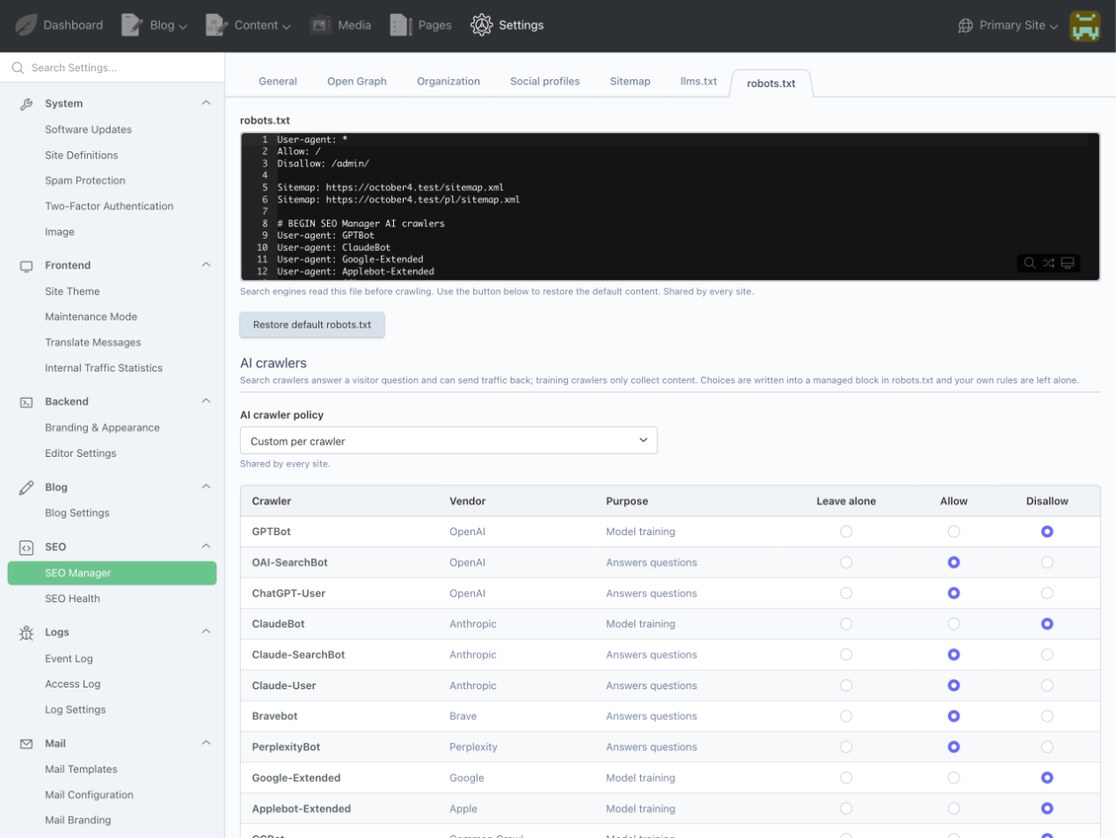
The robots.txt tab edits the file and sets an AI crawler policy: Leave alone, Allow AI search, block training, Allow all, Block all or Custom per crawler.
| Purpose | Crawlers |
|---|---|
| search (answers questions, sends traffic) | OAI-SearchBot, ChatGPT-User, Claude-SearchBot, Claude-User, Bravebot, PerplexityBot, Amazonbot |
| training | GPTBot, ClaudeBot, Google-Extended, Applebot-Extended, CCBot, Bytespider |
The policy is written into a managed block; your own rules stay untouched, and the tab warns when they already define a group for one of these crawlers:
# BEGIN SEO Manager AI crawlers
User-agent: GPTBot
Disallow: /
# END SEO Manager AI crawlers
Event::listen('seo.extendAiCrawlers', function (array &$crawlers) {
    $crawlers[] = ['agent' => 'AcmeBot', 'vendor' => 'Acme', 'purpose' => 'training'];
});
Multisite and translations
| Content | Native multisite | RainLab.Translate |
|---|---|---|
| Tailor entries | per site (text fields translatable: true) |
n/a |
Models with SeoModel |
per site with the Multisite trait |
per locale when the model declares $translatable |
| CMS pages and static pages | per theme, per locale in the Translate SEO popup | per locale in the Translate SEO popup |
The behavior adds the SEO fields to $translatable only where the model declares it, so October's Translatable
trait keeps them per locale too. CMS page SEO lives in the page file: sites sharing a theme share it. Without
RainLab.Translate the Translate SEO popup has a tab per language of the sites serving the theme. A CMS page title
falls back from the translated SEO title to the translated meta title to the page title.
RainLab.Translate is legacy: still read, no longer developed. The RainLab.Translate data check on SEO Health lists what only it still holds and the command that moves it:
php artisan translate:import-attributes
php artisan translate:import-theme --theme=demo
php artisan translate:import-attachments
php artisan translate:import-mail
Translated CMS page view bag keys (localeTitle, localeSeo_*, ...) need no migration; the core reads them.
Extending SEO fields
Event::listen('seo.extendSeoFields', function (array &$fields) {
    $fields['meta_author'] = ['label' => 'Author', 'tab' => 'renatio.seomanager::lang.tab.meta'];
});
Add the matching column to every table of a SeoModel model (for Tailor, to the blueprint, then tailor:migrate).
The field appears in model, static page and CMS page forms (except field types the page settings cannot show), is
inherited like the built-in fields and is available as {{ seoTag.meta_author }} in an overridden
seotags/default.htm partial. seo.extendOgFields works the same for the Open Graph tab. Both events fire on every
page render, so keep listeners free of queries and backend-only calls.
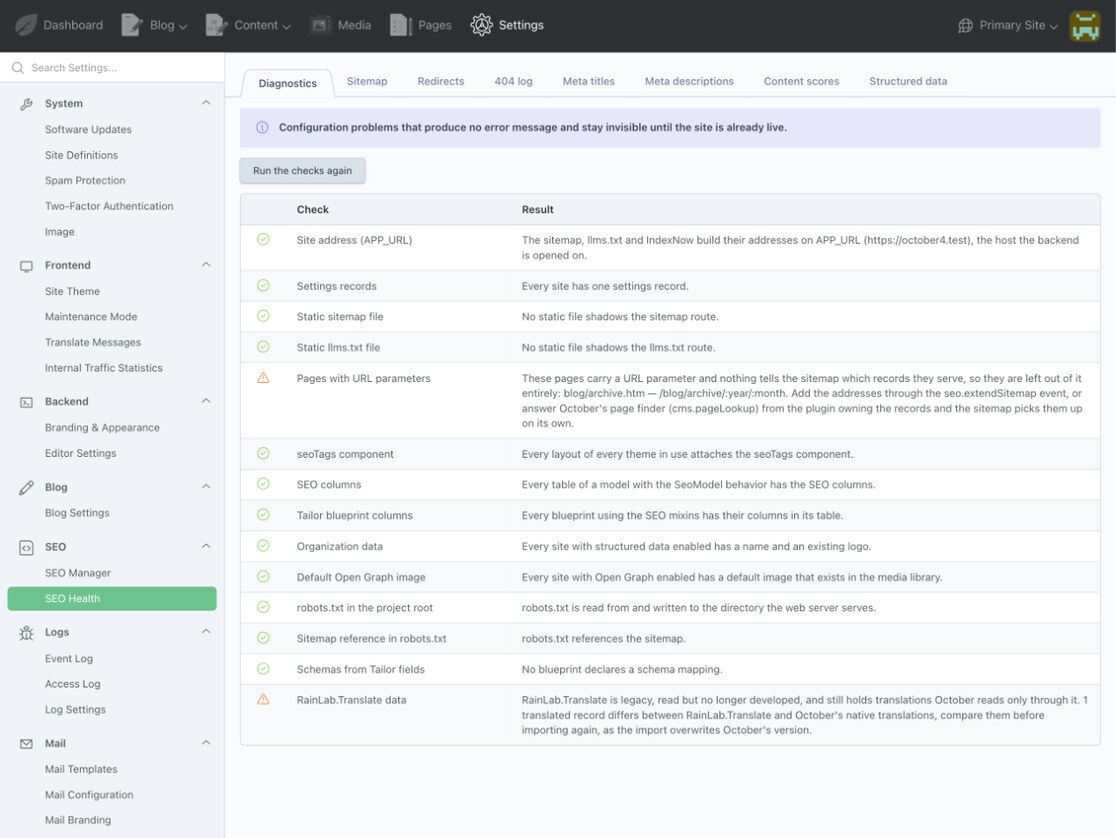
SEO Health
Settings > SEO > SEO Health, its dashboard widget and seo:doctor report what fails silently. seo:doctor exits
non-zero only on a failed check, so it fits a deploy or CI step.
| Check | Catches |
|---|---|
| Site address (APP_URL) | APP_URL not matching the backend host or scheme |
| Settings records | a site with more than one settings record (with a button removing the unused ones) |
| Static sitemap file / Static llms.txt file | files in the web root that shadow the plugin (with a delete button) |
| Pages with URL parameters | pages the sitemap cannot fill |
| seoTags component | a theme without the component |
| SEO columns / Tailor blueprint columns | tables missing SEO columns (with fix buttons) |
| Organization data / Default Open Graph image | missing site name, deleted logo, no default image |
| Schemas from Tailor fields | broken seoSchema mappings |
| RainLab.Translate data | translations only RainLab.Translate holds |
| robots.txt in the project root | a root copy the web server no longer serves from public |
| Sitemap reference in robots.txt | no Sitemap: line |
The page also has the Sitemap status of every site, the Structured data preview, Redirects, the 404 log,
and three audits run on a button or from the console, kept until the next run, settings save or cache:clear:
| Tab | Command | Reports |
|---|---|---|
| Meta titles | seo:titles |
missing, under 30 or over 60 characters with prefix and suffix, or reused |
| Meta descriptions | seo:descriptions |
missing, repeating the title, under 50 or over 160 characters, or reused |
| Content scores | seo:analyze |
the content analysis score of every static page, entry and record, weakest first |
The audits cover every enabled site, compare within one site and locale, skip noindex, drafts and Twig expressions,
and link each row to its edit form. Name the form of your own models:
Event::listen('seo.audit.editUrl', function ($record, &$url) {
    if ($record instanceof Product) {
        $url = Backend::url('acme/shop/products/update/' . $record->getKey());
    }
});
Add a diagnostics check: extend Renatio\SeoManager\Classes\Diagnostics\Check, implement key() and run() returning
ok(), warning() or error(), label it under diagnostics.<key> in your app/lang override, and register an
instance:
Event::listen('seo.registerDiagnosticChecks', function (array &$checks) {
    $checks[] = new \Acme\Blog\Classes\FeedCheck;
});
Console commands
| Command | Options | Does |
|---|---|---|
seo:doctor |
--locale= |
runs the SEO Health checks; fails only on a failed check; the last line counts failed, warned and passed checks |
seo:titles |
--locale=, --max-rows= |
meta title audit; fails when a table could not be read |
seo:descriptions |
--locale=, --max-rows= |
meta description audit; fails when a table could not be read |
seo:analyze |
--band=poor\|fair\|good, --limit=50, --fail-on=, --max-rows=, --locale= |
content scores; --fail-on=poor fails on any Poor row, fair on Fair or worse; unreadable rows or a pass cut short at --max-rows (20 000 by default) fail too |
seo:sitemap |
--clear |
rebuilds the sitemap of every enabled site, naming the sites skipped because it is off |
seo:llms |
--clear |
rebuilds llms.txt and llms-full.txt, naming the sites skipped because both are off |
seo:indexnow |
{url}, --all, --scheduled |
submits to IndexNow (exit codes under IndexNow) |
seo:migrate-tables |
--table=, --force |
adds the missing SEO columns to SeoModel tables after a confirmation, which a --table no SeoModel model uses asks for too |
seo:import-cms / seo:import-static |
--dry-run, --force |
imports SEO values from CMS pages / static pages; --dry-run lists the theme files it would rewrite |
seo:import-blog |
imports SEO values from blog posts and categories | |
seo:patch 3.0 |
--force |
moves data from renatio_seomanager_seo_tags (upgrade to 3.0) |
--force skips a confirmation; a declined one, or one a non-interactive run cannot ask, exits 1, so deploy scripts
pass --force. --locale translates the labels only, the audits read the content in the site's language.
php artisan seo:analyze --band=poor --limit=200
php artisan seo:analyze --fail-on=poor --max-rows=50000
Configuration files
Create config/renatio/seomanager/<file>.php in your project with only the keys you change.
| File | Keys |
|---|---|
htaccess.php |
tab: true, false or null (detect) |
migrate.php |
add_seo_columns: add SEO columns on october:migrate |
canonical.php |
query_params: the page-number parameters the canonical keeps (['page']) |
indexnow.php |
endpoint, debounce, bulk_threshold, timeout, frontend_fields |
record_image.php |
sources, search_attachments |
content_text.php |
sources |
og_locales.php |
language → Open Graph locale |
social_icons.php |
service → name, viewBox, path (prefer seo.extendSocialIcons) |
ai_crawlers.php |
the crawler list (prefer seo.extendAiCrawlers) |
Events
| Event | Arguments | Use |
|---|---|---|
seo.beforeComponentRender |
$component, $page |
assign $component->seoTag |
seo.extendSeoFields / seo.extendOgFields |
&$fields |
add or change form fields |
seo.extendOgTypes |
&$types |
add OG types |
seo.extendOgLocales |
&$locales |
change the language → locale map |
seo.extendImageSources |
&$sources, $model |
image attribute names per model |
seo.extendJsonLd |
&$schemas, $seoTag, $settings, $isMissingAddress |
add or change schemas |
seo.extendSchemaMapping |
&$mappings, $record |
schema mappings without a blueprint |
seo.extendSocialIcons / seo.extendSocialProfiles |
&$icons / &$profiles, $settings |
icons and profiles |
seo.alternateSites |
&$sites |
sites of the hreflang set |
seo.extendHreflang |
&$links, $controller |
hreflang links of a page |
seo.extendSitemap |
&$sitemap |
add sitemap URLs |
seo.blogPostModel |
return a Post subclass |
|
seo.extendLlmsTxt / seo.extendLlmsContent |
&$sections / &$content, $descriptor |
llms documents |
seo.extendAiCrawlers |
&$crawlers |
add AI crawlers |
seo.resolveContentText |
&$text, $record, $posted |
body text for the analysis |
seo.extendAnalysisChecks |
&$checks |
add analysis checks |
seo.registerDiagnosticChecks |
&$checks |
add SEO Health checks |
seo.audit.editUrl |
$record, &$url |
edit link in the audits |
-

Marco Inward
Great plugin. But what's going on with the plugin when adding blogs? It is duplicated and takes up the whole page, making it super difficult to scroll and write blogs. Please fix! ?
-

Renatio author
Thank you for the review! The duplicated fields were fixed in v1.3.3. Today the SEO and Open Graph fields sit on their own tabs of the post form, out of the way of the editor.
-

CodeForge SRL
Would recommend keeping it in your standard developer toolbelt for OctoberCMS sites.
-
Renatio author
Thank you, glad it earned a place in your toolbelt!
-

bitcraft gmbh
Hi, is there a solution to have translation?
Currently commented:
/*
- Currently RainLab.Translate Plugin does not support relation fields, waiting for fix. */ //$this->model->translatable = array_merge($this->model->translatable, (new SeoTag)->translatable);
-
Renatio author
Sorry for the very late reply! That comment belonged to the old
seo_tagrelation, which RainLab.Translate couldn't translate. Since v3.0 the SEO fields are columns on the model's own table and theSeoModelbehavior adds them to$translatable, so they translate like any other field. With October's multisite they are stored per site. -

Cy Messenger
Awesome plugin! However, when I collapse the component to reveal the html markup, the plugin no longer works i.e. the component variables don't pull through any SEO data.
Any ideas on how to fix this?
I am running SEO Manager version 1.2.2 and October build 454.
Cheers,
-
Renatio author
Sorry for the very late reply! The component prepares its variables while it renders, so once the markup is expanded into the layout and
{% component 'seoTags' %}is gone, nothing fills them. Keep the tag and override the component's partial in your theme instead: copyplugins/renatio/seomanager/components/seotags/default.htmtothemes/your-theme/partials/seoTags/default.htmand edit it there. The plugin's updates leave your copy alone, but check the upgrade guide for partial changes. -

Gergo Csoma
I love this plugin. But somehow in my front page, the seo title get a plus seo title, which comes from blog categories... How can i fix this?
-
Renatio author
Sorry for the long wait! Since v8.0 the tags come from the record the address points to, so on a page without URL parameters a blog category or a featured post shown on it no longer takes over the title. If your front page still shows a category title after updating, please open an issue with the page's components: https://github.com/mplodowski/seomanager-plugin-public/issues
-

Taï-nui
Great plugin, easy and intuitive to set up, congratulations !
However i wonder if this is an issue : why the fields which are translatable into StaticPages context are not translatable into blog post context ? Possible fix please ? :)
Best regards and happy Xmas
-
Renatio author
Thank you, and sorry for the very late reply!
This has long been fixed: the SEO and Open Graph fields of blog posts and categories are translatable just like on static pages, through RainLab.Translate or RainLab.Blog's own multisite translations.
-

Max
This plugin is essential for most of my projects, however I do have my own SEO fields in most of cases in my plugin's models. Using Event::listen beforeComponentRender and injecting my own data to the component. Since almost all my projects are multilingual this is very useful and I'm in full control of my language fields. I also have to rewrite the components default.htm since og:image in a default version can only be taken from Media finder. By adding few IF ELSEs I can use images from any place now.
-
Renatio author
Thanks, Max, and sorry for the very late reply!
Your setup still works:
seo.beforeComponentRenderis the supported way to hand your own record to the component. Theog:imageoverride is no longer needed though. When OG Image is empty, the plugin takes the record's own image: an attribute or anattachOne/attachManyrelation namedimage,images,photo,cover,banner,thumbnailand similar, then any other public image attachment. An absolute URL works too. Add your own names per model:Event::listen('seo.extendImageSources', function (array &$sources, $model) { $sources[] = 'cover_photo'; });For multilingual sites, the SEO fields are translatable per site with October's multisite, or through RainLab.Translate.
-

Gavin Foster
Amazing plugin. Works out of the box and this is how SEO should be in OcotberCMS! Just one tiny problem...
Meta Robots Index and Meta Robots Follow don't do anything when I change the values to no index and no follow on a static page.
<meta name="robots" content="{{ seoTag.robots }}">outputs:
<meta name="robots" content="index, follow">
and I want it to say when I set no index and no follow on the SEO tab of a page:
<meta name="robots" content="noindex, nofollow">
Thank you in advance!
-
Renatio author
Thanks, Gavin! This was fixed in v1.2.2. Today you don't need to write the robots tag yourself: place
{% component 'seoTags' %}in the head of your layout and it rendersnoindex, nofollow(and every other tag) from the page's SEO tab, including static pages. -

Donovan Avila Pardo
beautiful
-
Renatio author
Thank you, Donovan!
-

Paul
It's like magic! But.. can you make the "SEO Title" and "Og Title" just copy/use the same as the "Post title"? The same for the description! It's kinda annoying to write the same thing 3 times.
Everything else is just wonderful!
Cheers!
-
Renatio author
Thanks, Paul!
Just leave them empty. When you save a blog post, a blank SEO Title takes the post title and a blank Meta Description the excerpt (or the start of the content). A blank OG Title and OG Description fall back to the SEO ones. This is now described in the README under Where the tags come from and Open Graph.
-

Mathieu Tanguay
I experienced a crash at installation because my meta_description from my blog was too long.
According to the version.yaml. This is what happens: In 1.0.1: Set meta_description to length of 160 In 1.0.2: Call the import default command which checks that the field does not go over 255 In 1.1.5: Increase the field length to 255
In my case, I had to remove the line with import_default_values.php, reinstall the plugin and then run manually the import command.
The call to import_default_values.php should be moved after 1.1.5 in version.yaml.
-
Renatio author
Thank you for the detailed report! It was fixed in 1.1.10: installation no longer runs the import, so long blog descriptions can't break it. Importing existing CMS and static page values is now a separate step you run when you want it (
php artisan seo:import-cms,php artisan seo:import-static). -

Andrew Till
Absolutely brilliant. Very quick to install and I love the way it works with models.
-
Renatio author
Thank you, Andrew! Models are still at the core: any model with the
SeoModelbehavior gets the SEO tab, and since v8.0 its records also get content analysis and show up on the SEO Health page. -

Devin Green
Best SEO plugin. Would be even better if you extended it to JKShop
-
Renatio author
Thank you!
You don't need JKShop to change anything. Add the behavior to its model from the
boot()method of your own plugin:\Acme\Shop\Models\Product::extend(function ($model) { $model->implement[] = 'Renatio.SeoManager.Behaviors.SeoModel'; });Then run
php artisan october:migrate(orphp artisan seo:migrate-tables --force) to add the SEO columns to its table, and the model gets an SEO tab in its form. The same works for any third-party model. -

Alpen.Space
Thank you for this nice plugin. You don't need much time to set it up. Everything is self-explanatory.
It would be nice if the meta title and the description are translatable. Can you add this feature please?
-
Renatio author
Thank you! Meta title and description have been translatable for a long time now: per site with October's multisite (Tailor entries, CMS pages and the settings, which are stored per site since v8.0), and through RainLab.Translate on older setups. Sorry this reply comes so late.
-

Gerald Schandl
Great plugin! Helps a lot!!!
-
Renatio author
Thank you, Gerald, glad it helps!
-


| 8.1.0 |
Show page titles in each site's language in llms.txt, add DescribedUrl for seo.extendSitemap listeners. Nov 06, 2026 |
|---|---|
| 8.0.1 |
Fix a TypeError when a RainLab.Pages static page opens in the backend. Nov 06, 2026 |
| 8.0.0 |
Require October CMS 4.4 and store the SEO settings per site. Nov 05, 2026 |
| 7.3.2 |
Hand /sitemap.xml to the CMS when the sitemap is disabled, so a theme page under that address can answer instead of a 404. Sep 16, 2026 |
| 7.3.1 |
Allow spatie/laravel-sitemap 8.0.1 and newer, which no longer requires Guzzle 7, on PHP 8.4 and newer. Aug 28, 2026 |
| 7.3.0 |
Fall back to the CMS page for SEO fields a Tailor entry or SeoModel record leaves blank, in the tags and the sitemap alike. Aug 28, 2026 |
| 7.2.3 |
Fix robots.txt and .htaccess paths to resolve against the web root and never overwrite .htaccess with empty content. Aug 28, 2026 |
| 7.2.2 |
Add --force option to seo:migrate-tables, warn when the confirmation is declined, add PHPStan and Rector. Aug 28, 2026 |
| 7.2.1 |
Improve breadcrumbs accuracy, clean error page tags, add console command tests. Aug 28, 2026 |
| 7.2.0 |
Add WebSite and BreadcrumbList structured data schemas. Aug 28, 2026 |
| 7.1.2 |
Serve noindex robots on error pages. Aug 28, 2026 |
| 7.1.1 |
Fix sitemap hreflang alternates, sitemap route prefix validation and JSON-LD output escaping. Aug 28, 2026 |
| 7.1.0 |
Add XML sitemap generation. Aug 28, 2026 |
| 7.0.1 |
Add hreflang alternate language tags for multisite. Aug 28, 2026 |
| 7.0.0 |
Add JSON-LD structured data support. Aug 28, 2026 |
| 6.1.2 |
Remove composer/installers dependency. Aug 28, 2026 |
| 6.1.1 |
Make Tailor blueprint SEO fields translatable for multisite. Aug 28, 2026 |
| 6.1.0 |
Add automated test suite. Modernize codebase for PHP 8.4. Aug 28, 2026 |
| 6.0.3 |
Remove obsolete blueprint copy migration. Fix docs typos. Aug 28, 2026 |
| 6.0.2 |
Update dependencies. Jul 12, 2025 |
| 6.0.1 |
Support October 4. Jul 07, 2025 |
| 5.0.6 |
Make og image translatable. Allow to set default og image with component event. Sep 11, 2024 |
| 5.0.5 |
Update SEO chars limit to latest recommendations. Nov 24, 2023 |
| 5.0.4 |
Fix extending SEO Tag. Jan 15, 2023 |
| 5.0.3 |
Add demo URL. Nov 12, 2022 |
| 5.0.2 |
Fix Tailor SEO blueprints. Nov 08, 2022 |
| 5.0.1 |
Improve default value for import CMS pages. Nov 08, 2022 |
| 5.0.0 |
Require October CMS 3.1. Add support for Multisite. Oct 15, 2022 |
| 4.0.2 |
Fix twitter media link. Jul 11, 2022 |
| 4.0.1 |
Composer config. Jun 17, 2022 |
| 4.0.0 |
Require October CMS 3.0. Add October CMS Tailor support. Jun 13, 2022 |
| 3.1.2 |
Fix error on migration Translate plugin. Feb 23, 2022 |
| 3.1.1 |
Add check for Translate plugin. Feb 23, 2022 |
| 3.1.0 |
Require October CMS 2.1. Jan 04, 2022 |
| 3.0.1 |
Fix issue with migration tables console command. Sep 21, 2021 |
| 3.0.0 |
Add support for translatable SEO fields for models. Sep 20, 2021 |
| 2.0.2 |
Update documentation. Sep 17, 2021 |
| 2.0.1 |
Add support for October v2.0. Drop support for October v1.0. Sep 17, 2021 |
| 1.3.4 |
Fix config for media path issues. Aug 05, 2021 |
| 1.3.3 |
Fix adding SEO fields twice error. Feb 10, 2020 |
| 1.3.2 |
Fix repeater field error on Static Pages. Feb 10, 2020 |
| 1.3.1 |
Fix link policy ignored in currentUrl. Thanks @petehalverson. Feb 07, 2020 |
| 1.3.0 |
Fix CMS pages translation. Feb 07, 2020 |
| 1.2.2 |
Fix issue with robots and 301 redirect properties. Nov 17, 2018 |
| 1.2.1 |
Fix issue with extending form fields for models. Nov 17, 2018 |
| 1.2.0 |
!!! Change event parameters for plugin extension. See upgrade guide. Nov 17, 2018 |
| 1.1.11 |
Add default value for meta robots tag. Jul 13, 2018 |
| 1.1.10 |
Fix installation and import issues. Jul 10, 2018 |
| 1.1.9 |
Fix adding SEO fields to pivot models (edge case). Feb 25, 2018 |
| 1.1.8 |
Ensure OG image dimensions are set. Feb 02, 2018 |
| 1.1.7 |
Fix adding SEO fields inside repeater fields. Feb 02, 2018 |
| 1.1.6 |
Make polymorphic fields nullable. Feb 02, 2018 |
| 1.1.5 |
Increase meta title and description fields length. Feb 02, 2018 |
| 1.1.4 |
Fix adding SEO fields for model with pivot Dec 02, 2017 |
| 1.1.3 |
Fix attaching morphOne relation to model. Nov 24, 2017 |
| 1.1.2 |
Fix attaching SEO fields to model with empty tab fields. Nov 24, 2017 |
| 1.1.1 |
Fix RainLab.Blog installation issue. Nov 24, 2017 |
| 1.1.0 |
!!! Update only for Laravel 5.5 LTS Aug 14, 2017 |
| 1.0.7 |
Fix showing Seo fields in repeater Apr 22, 2017 |
| 1.0.6 |
Fix repeater field error in RainLab.Pages plugin Mar 12, 2017 |
| 1.0.5 |
Fix spaces on prefix/suffix title Sep 01, 2016 |
| 1.0.4 |
Fix bug for PHP version < 5.6 Aug 31, 2016 |
| 1.0.3 |
Import SeoExtension Settings Aug 05, 2016 |
| 1.0.2 |
Import data Jul 30, 2016 |
| 1.0.1 |
First version of Seo Manager Jul 26, 2016 |
Upgrade guide
Versions not listed here need no action. Back up the database before upgrading.
Upgrading To 1.1.0
Plugin requires October CMS build 420+ with Laravel 5.5 and PHP >=7.0.
Upgrading To 1.2.0
The seo.beforeComponentRender event now receives $component as the first parameter and $page as the second.
Access the SEO tag through $component->seoTag.
Upgrading To 2.0.1
Plugin requires October CMS 2.x with Laravel 6 and PHP >=7.2.9.
Upgrading To 3.0.0
The seo_tag relation on models implementing the SeoModel behavior is gone; SEO fields are now columns on the
model's own table. Run:
php artisan seo:migrate-tables
php artisan seo:patch 3.0
The first adds the columns to every table of a model implementing the behavior, the second moves the data over from
renatio_seomanager_seo_tags.
Listeners of seo.beforeComponentRender now assign the model itself instead of its seo_tag relation:
$component->seoTag = $page->controller->vars['product'];
Upgrading To 3.1.0
Plugin requires October CMS 2.1 or higher.
Upgrading To 4.0.0
Plugin requires October CMS 3.0 or higher, Laravel 9.0 or higher and PHP >=8.0.
Upgrading To 5.0.0
Plugin requires October CMS 3.1 or higher.
Upgrading To 6.0.1
Plugin requires October CMS 4.0 or higher.
Upgrading To 7.0.0
Plugin requires October CMS 4.1 or higher.
JSON-LD output is enabled by default after updating. Disable it in the settings if you do not want it.
The seo.extendSeoFields, seo.extendOgFields and seo.extendJsonLd events now pass data by reference. Listeners
modify the array directly instead of returning it:
Event::listen('seo.extendSeoFields', function (&$fields) {
    $fields['my_field'] = [...];
});
Upgrading To 7.1.0
The XML sitemap is disabled by default. Enable it in Settings > SEO > SEO Manager > Sitemap to serve
/sitemap.xml.
Upgrading To 7.1.1
If you have overridden the seotags/default.htm component partial, update the JSON-LD loop — each schema is
already a JSON string:
{% for schema in jsonLdSchemas %}
<script type="application/ld+json">{{ schema|raw }}</script>
{% endfor %}
Upgrading To 7.2.3
The Common meta tags field is now guarded by its own Change common meta tags permission. Grant it to the roles that should keep editing the field. Super users are unaffected.
Meta, og: and twitter: descriptions are now escaped, so HTML written into those fields no longer renders as
markup.
Cached sitemaps moved from storage/app to storage/app/seomanager and are rebuilt on the next request. The old
storage/app/sitemap-*.xml files are no longer read by anything and can be deleted by hand.
Upgrading To 7.3.0
A blank SEO field on a Tailor entry or a SeoModel record no longer produces an empty tag: it falls back to the same
field of the CMS page rendering it. Pages that relied on an entry blanking out a value set in the page's SEO tab now
render the page value — clear it from the page as well if that was intended. The canonical URL, the 301 redirect and
og:type are excluded from the fallback. The values are written onto the record while the seoTags component renders,
after the seo.beforeComponentRender event. The sitemap applies the same rule, so an entry with a blank robot_index
on a noindex page is no longer listed.
Upgrading To 7.3.1
Projects locked to Guzzle 8 could not install versions 7.1.0 to 7.3.0, as spatie/laravel-sitemap 7.x (and 8.0.0)
requires Guzzle 7; the plugin now also accepts spatie/laravel-sitemap 8.0.1 or newer, which needs PHP 8.4 or newer.
Run composer update renatio/seomanager-plugin -W to let Composer pick it.
Upgrading To 8.0.0
Requires October CMS 4.4. Run php artisan october:migrate: with add_seo_columns on (the default) it also adds the
new Focus Keyword column to SeoModel tables and to Tailor tables using the SEO mixins; where it is off, run
php artisan seo:migrate-tables --force and php artisan tailor:migrate. Then rebuild the sitemap.
- From a version below 7.2.3, upgrade to 7.3.2 first.
- Settings are stored per site; the migration copies the current ones to every site.
- Change the .htaccess file, Change common meta tags and the new Change robots.txt and the AI crawler policy, Change the allowed redirect hosts, Add the missing SEO columns and Delete the static sitemap file are Developer only; the new View SEO Health and run its checks goes to Developer and Publisher. Tick them for custom roles.
- The .htaccess tab shows only on Apache or LiteSpeed; elsewhere set
tabtotrueinconfig/renatio/seomanager/htaccess.php. Editing stays off until switched on in the tab. seo:migrate-tables,seo:patch,seo:import-cmsandseo:import-staticask for confirmation and exit 1 when it is declined or cannot be asked: pass--forcein deploy scripts, or dropseo:migrate-tableswhereoctober:migrateadds the columns.- The sitemap is rebuilt on a schedule (daily at 03:00), not on save: add the
schedule:runcron entry. - Delete any
sitemap.xml,sitemap.xsl,llms.txtorllms-full.txtin the web root; it shadows the plugin. - Sitemap, llms.txt, IndexNow and the default robots.txt build addresses on
APP_URL: make it the public address. - Slug redirects and the 404 log are on; switch them off on the General settings tab.
- A non-GET request to a slug redirect or to a 301 Redirect on a site host gets 308 instead of 301, so a posted form keeps its method and body.
- Removed:
Sitemap::buildForAllSites()(userebuildAllSites()), theRobotsTxtrule object (use theseo_robots_txtrule) and the Twitter/X creator setting with itstwitter:creatortag. $component->seoTagis a copy of the record: compare by key, not identity.seo.extendSeoFieldsandseo.extendOgFieldsrun on every public request, so keep them cheap.- On a page with URL parameters a record from the page variables is used only when it holds a parameter's value
(
/albums/:slugand itsslug); otherwise assign it inseo.beforeComponentRender. - Sites of different groups running one theme now share hreflang links; keep brands apart with
seo.alternateSites. Records of a model with theMultisitetrait link only the versions sharing asite_root_id. - The canonical tag names the record's own address and keeps
?page=Nof a paginated listing (page 1 without it); other parameters are dropped. Change the list inquery_paramsofconfig/renatio/seomanager/canonical.php. - A page whose canonical names another address leaves the sitemap.
og:localecarries a territory (de_DE), error responses except 503 getnoindex, nofollow, and the Organization schema carries the site URL: drop aseo.extendJsonLdlistener that added it.- Saving validates Canonical URL, Meta Robots Advanced (no
allornone) and a 255-character limit. - An empty body now fails Content length, so
seo:analyze --fail-on=poormay start failing in CI. - RainLab.Translate is legacy: SEO Health lists the translations only it still reads and the
translate:import-*command that moves them.