


We've relied on this plugin internally for a long time across a wide range of projects. With more engineering capacity now available, we've polished it up and are excited to share it with the OctoberCMS community. We have a strong end-to-end and unit test coverage for quality control. As our projects basically all have the same structure, we expect some bugs in more diverse setups. We're happy to address them when reported to us.
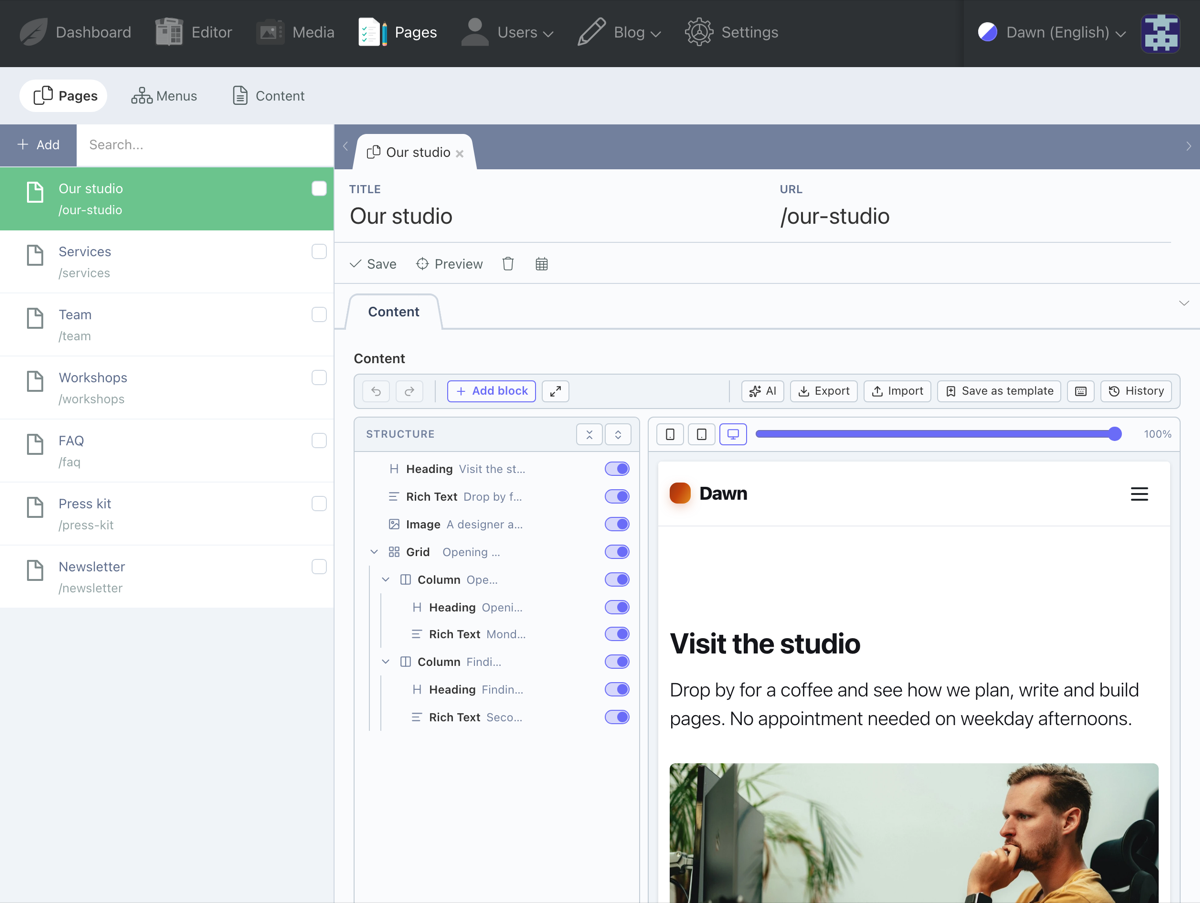
A visual block editor for October CMS. Editors build pages from nested blocks and see a live preview in your theme. Content is stored as clean JSON, and your theme keeps control of the markup.
Video tour: https://youtu.be/INNAS7JdLYw
For editors
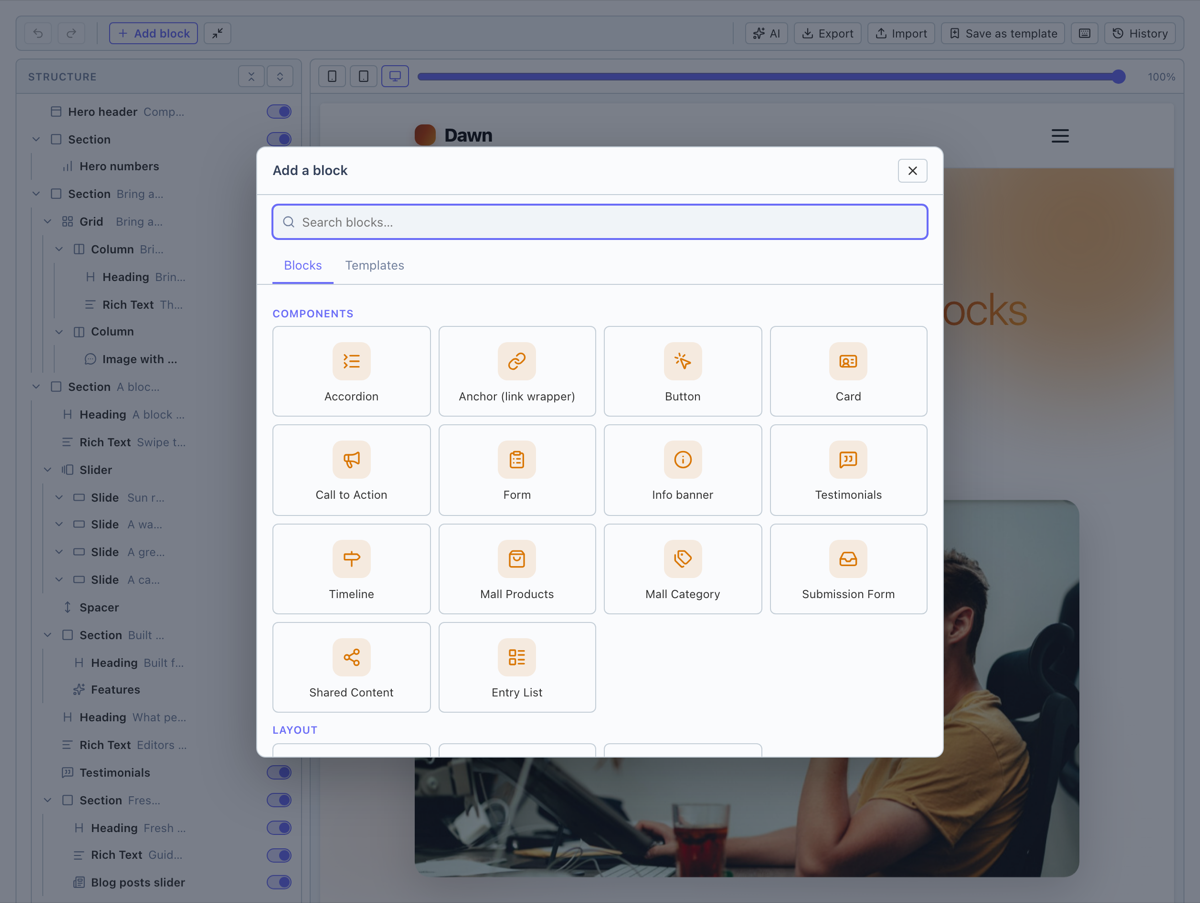
- Three-pane editor: structure tree, live preview, and an inspector for each block.
- 30+ blocks: text, images, galleries, video, sliders, cards, accordions, timelines, maps, PDFs, downloads, testimonials, call-to-actions, forms and layout grids.
- Versions: every save is a version. Compare, restore and pin; the audit log records who changed what.
- Reuse: templates for blocks or whole pages, and Shared Content that updates every page it appears on.
- Scheduling: show a block from or until a date.
- SEO check: a 0–100 score for headings, text length, alt text and link text.
- Copy and paste blocks between pages and sites.
- Keyboard first: shortcuts to add, move, duplicate and delete blocks; screen readers announce every structural change.
Works with
- Tailor entries and any backend form.
- RainLab.Pages static pages (2.x and 3.x).
- RainLab.Blog posts.
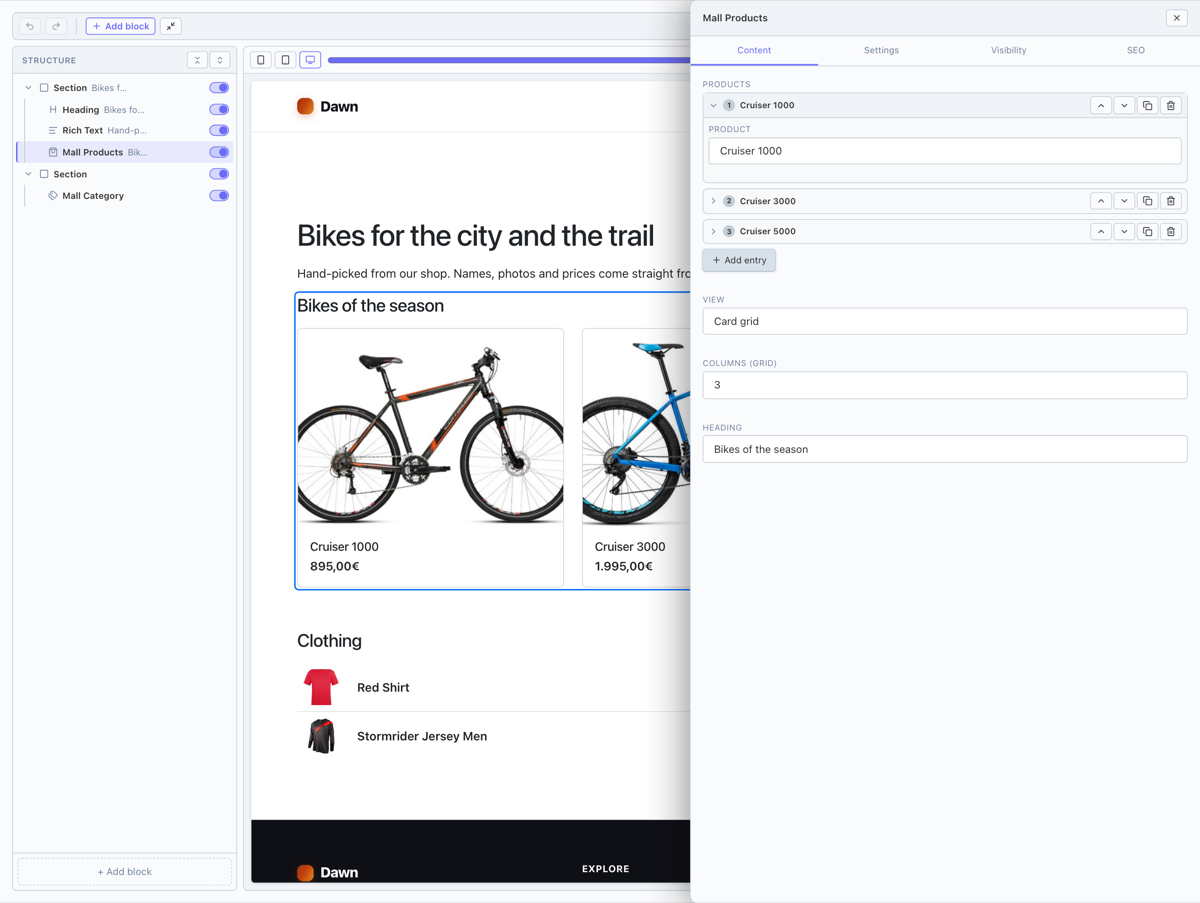
- OFFLINE.Mall: product and category blocks, plus a one-click shop scaffold.
- Tailor submission forms (October CMS 4.4+).
- Multisite: one document per site.
All integrations are optional and off by default. Existing content is never converted.
AI (optional, off by default)
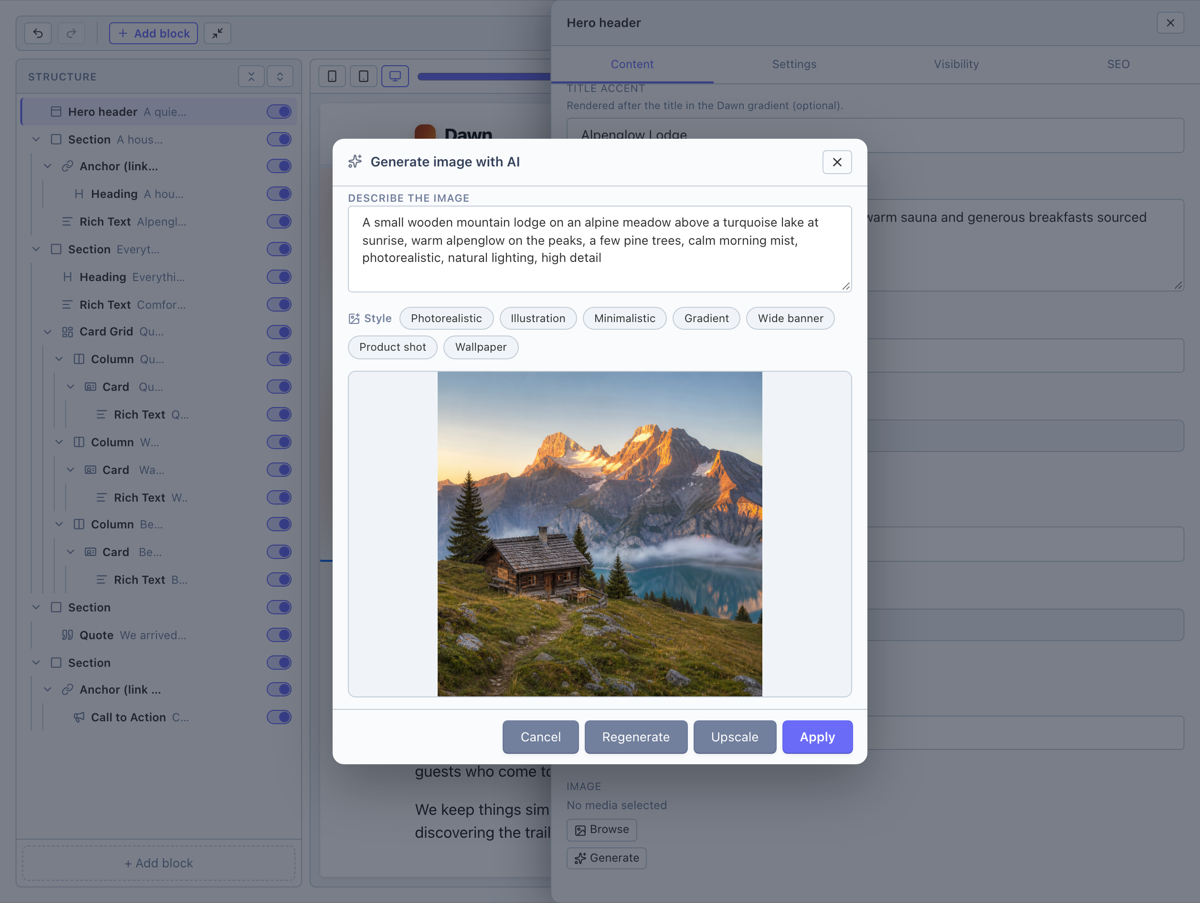
- Draft a page from a brief, or research the web first.
- Translate a document; structure and links stay intact.
- Generate and upscale images.
- Every text result shows the block changes before it is applied, and is kept in the version history.
- Uses your own OpenAI or OpenRouter key, with a monthly token budget.
Privacy by default
- YouTube and Vimeo load only after a click.
- Map tiles come through a caching proxy, so visitors never contact OpenStreetMap.
- The contact form has a honeypot, a rate limit and an optional local captcha. No external service.
For developers
- JSON documents with a published JSON Schema. The format is MIT licensed.
- Override any block's markup in your theme, or register your own blocks.
- PHP API, REST API (off by default, token-protected) and CLI for bundles with media.
New in 1.0.7
- OFFLINE.Mall: Mall Products and Mall Category blocks, shop scaffold.
- Tailor submission forms (October CMS 4.4+): pick, order and relabel fields; uploads stay private.
- Entry List block: Tailor entries as cards, image grid or list, with pagination or endless loading.
- RainLab.Pages 3.x support.
- Map tiles: cache size limit and region restriction.
- Keyboard-first editor with a shortcut reference.
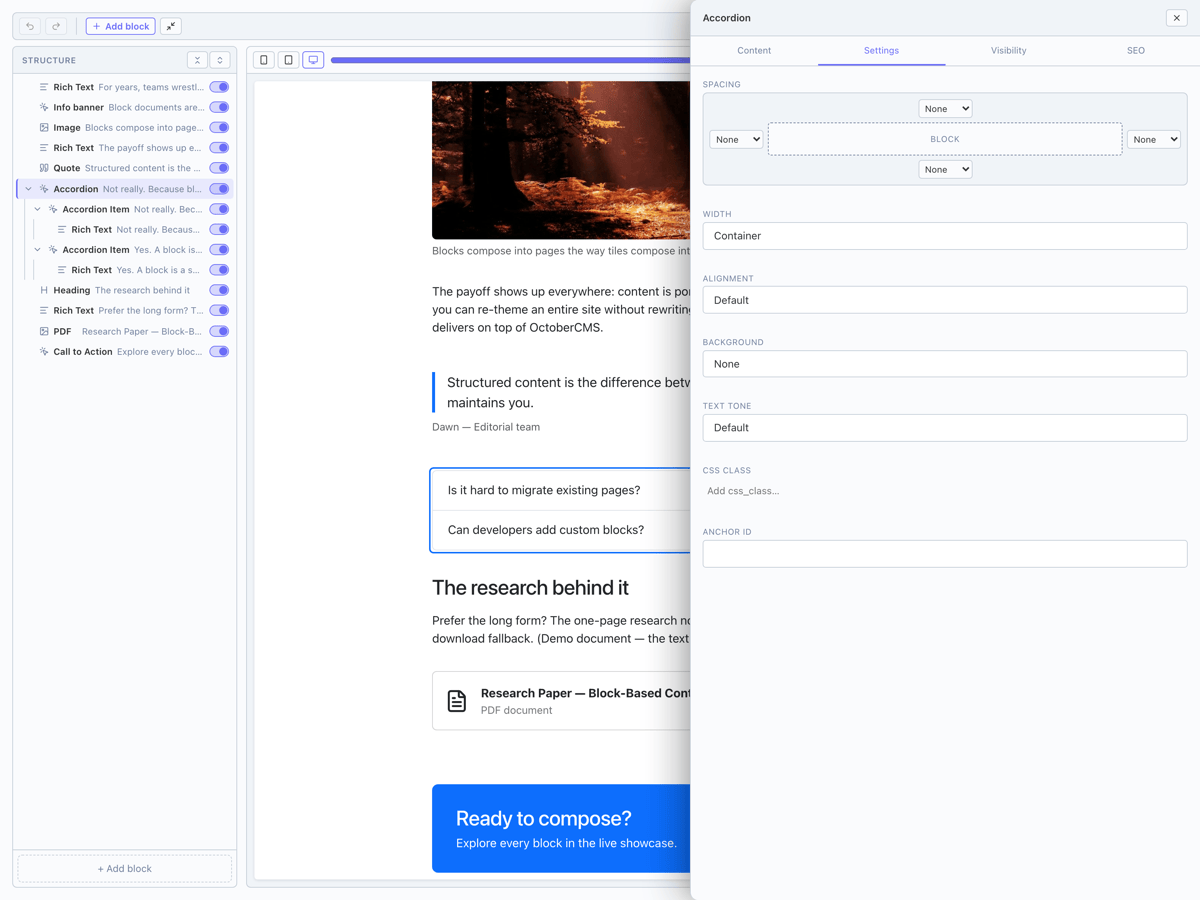
- Tabbed settings pages.
- Suggested CSS classes for block settings.
- AI model picker with provider defaults.
- Switches to hide the Settings and SEO tabs, e.g. for client accounts.
- October CMS 4.1 to 4.4 supported.
Upgrading from 1.0.6: the Twig filter |content is now |rc_blocks. See the Documentation tab.
Requirements
- October CMS 4.1 to 4.4, PHP 8.2 or newer.
- No required plugins. Optional: RainLab.Pages, RainLab.Blog, OFFLINE.Mall. Submission forms need October CMS 4.4.
- AI needs an OpenAI or OpenRouter API key; web research also needs a Firecrawl key.
- Backend in English, German, Spanish, Czech and Polish.
Free theme
Renick.Dawn (free, MIT) shows every block, the shop and the forms.
License and support
Commercial license per installation; local evaluation is free. Docs: renick.io/en/content-plugin. Questions: talk.octobercms.com. Bugs and contact: renick.io/en/kontakt.

Installation via Command Line
php artisan plugin:install Renick.Content
Renick.Content
Block-based content editing for OctoberCMS 4.3. A content document is a list of typed blocks (heading, rich text, image, button, section, and more) stored as JSON in a host field, edited with a backend block editor, and rendered on the frontend through a fallback-safe renderer.
Official landing page: https://www.renick.io/de/content-plugin
Install
The plugin registers itself through the standard OctoberCMS discovery. With the
plugin in plugins/renick/content:
php artisan october:migrate      # boots the plugin
php artisan plugin:list          # shows: Renick.Content
Usage
Tailor entries
Add a contenteditor field to a blueprint:
fields:
    content:
        label: Content
        type: contenteditor
The field stores the document JSON in a longText column and renders the block
editor in the entry form.
Backend forms
The same widget is available to any backend form as type: contenteditor.
Frontend rendering
Render a stored document on a CMS page with the component:
[renickContent]
==
{% component 'renickContent' document=post.content %}
…or inline with the Twig function anywhere in a theme:
{{ content_render(post.content)|raw }}
Both funnel through BlockRenderer, which resolves each block's partial
theme override → plugin default → safe placeholder and never throws on a
missing or unknown block (D10): the offending block degrades to an HTML comment
(plus a visible card in debug) while its neighbours still render.
Blocks
| Handle | Group | Purpose |
|---|---|---|
heading |
text | h1–h6 heading |
richtext |
text | HTML rich text, edited with a TipTap editor in the Inspector |
quote |
text | Blockquote with author + role |
image |
media | Media image with alt, caption and optional link |
gallery |
media | Multi-image field (array or one path per line), optional captions |
video |
media | YouTube/Vimeo privacy embed or media-library <video> |
slider / slide |
media | Slideshow container and its slides |
pdf |
media | Embedded PDF from the media library |
map |
media | Privacy-proxied map (tiles served through the plugin) |
button |
components | Labelled link/button |
cta |
components | Call-to-action block |
card |
components | Card with image, text and link |
accordion / accordion-item |
components | Collapsible sections (with an FAQ variant) |
timeline / timeline-item |
components | Vertical timeline and its entries |
anchor |
components | Named anchor / link wrapper |
shared |
components | Reference to a reusable Shared Content document |
placeholder |
utility | Named slot bound to a Custom Script (JS) |
section |
layout | Container that nests child blocks |
grid / column |
layout | Column container (2/3/4) and its columns |
card-grid |
layout | Grid of cards |
spacer |
utility | Explicit vertical whitespace (xs–xl) |
Every block also carries generic settings (spacing top/bottom, width,
CSS class, anchor id — rendered as rc-* utility classes) and visibility
(on/off toggle, show-from / show-until schedule, evaluated server-side at
render time). The document format is published as JSON Schema in
schema/document-v1.json.
Each block is a YAML definition plus a default partial in
blocks/<handle>/. A theme may override a partial at
partials/renick-content/<handle>.htm; the default guarantees rendering never
breaks.
Layout
classes/        BlockDefinition, ContentDocument, VisibilityRules, BlockManager, BlockRenderer,
                StaticPagesIntegration, RainLabBlogIntegration
blocks/         block definitions (YAML) + default partials
console/        Artisan commands (export/import bundle, prune versions/proxy cache, reindex media, seed demo)
formwidgets/    ContentEditor form widget (mount partial; UI ships in assets/dist)
contentfields/  ContentEditor Tailor content field
components/     Content component (renickContent)
assets/src/     Editor source — TypeScript + React 18 + TipTap 3 (see INITIAL_PLAN.md#25-the-editor)
assets/dist/    COMMITTED editor bundle (single ESM file + css)
tests/unit/     PHPUnit suite
Editor build
The backend editor is a TipTap 3 / React island bundled with Vite (pnpm).
Consumers never build anything — assets/dist is committed and shipped.
cd plugins/renick/content
pnpm install
pnpm run typecheck && pnpm test   # TS + Vitest (converter round-trips, fuzz, constraints)
pnpm run build                    # rebuild assets/dist (CI fails if stale)
AI & REST API
AI features are disabled by default. Configure them under
Settings → Renick Content AI: provider (OpenAI, OpenRouter, or the offline
mock driver for testing), API keys (encrypted at rest), per-feature models,
an image-generation model and storage target, a monthly token budget (warn-only)
and the Firecrawl research toggle.
In the editor toolbar the AI menu offers Translate… (values only —
structure, ids and URLs stay untouched), Draft from brief… and Research &
draft… (Firecrawl-gathered sources; requires the privacy toggle); the image
block can generate images from a prompt. Every AI result shows a block-diff
confirmation modal before it is applied, and records an auditable
ai_translate / ai_draft version.
Custom Scripts (JS bound to a placeholder block) can be AI-generated behind
a review gate: generated code is loaded into the form for the admin to review
and only becomes public once they save it, with create/update logging and a
created_by/updated_by audit trail.
The REST API is off by default. Enable it plus a bearer token in the AI
settings; endpoints live under /api/renick/content/v1:
GET  /document?host_type=&host_id=&field=   # document + media manifest
PUT  /document                              # write (normalize + validate)
GET  /document/bundle?host_type=&host_id=&field=  # export document + media as a ZIP
POST /document/bundle                       # import a ZIP bundle
POST /translate                             # {host…, target_language}
POST /draft                                 # {brief, template_id?}
POST /duplicate                             # {document} → re-id'd copy
GET  /templates
GET  /versions?host_type=&host_id=&field=
POST /restore                               # {host…, version_id}
All requests: Authorization: Bearer <token>. Writes snapshot the previous
state first and record the action in the audit log. The same service classes
back the editor (Renick\Content\Classes\Content facade for PHP consumers).
The group is rate-limited (default 60 requests/minute, keyed by token then
client IP) and enforces body-size caps (2 MB for a document, 50 MB for a
bundle → HTTP 413 on overflow). All limits are overridable via env or
config/renick/content/limits.php — see config/limits.php.
Plugin integrations
Two opt-in integrations let the block editor take over content fields in other plugins, configured under Settings → Content Editor → Integrations. Each switch is inert unless the matching plugin is installed, and neither is a hard dependency:
- RainLab.Pages — edit a static page's content with the block editor. The swap happens only for pages whose markup is empty or already a block document; existing HTML pages keep the rich editor untouched.
- RainLab.Blog — edit a blog post's
contentwith the block editor. Same rule: only empty or already-block posts switch; existing Markdown posts are untouched. The renderedcontent_htmlis generated from the block document on save, so the stock RainLab blog components keep working.
Command line
Artisan commands (run from the October install root):
php artisan renick:content:export-bundle --host=… --id=… [--field=content] [--out=file.zip] [--dry-run]
php artisan renick:content:import-bundle --host=… --id=… --in=file.zip [--overwrite-media] [--force] [--dry-run]
php artisan renick:content:prune-versions [--days=180]   # delete unpinned versions older than N days
php artisan renick:content:prune-proxy-cache             # clear expired map-tile / video-thumbnail cache
php artisan renick:content:reindex-media                 # rebuild the media usage index
php artisan renick:content:seed-demo [--section=Content\\Article]  # demo entry with every block
Both bundle commands accept --dry-run to print exactly what they would
read/write without touching the filesystem or the database.
License
Renick.Content is proprietary, commercial software — source-available, not open source. Being able to view the source code does not grant a right to use it. Any production use requires a valid, paid license per installation / per site, purchased from the Licensor. Local, non-production evaluation is permitted.
The block-based content format (its specification and schema) is separately licensed under MIT, so authored content stays portable and interoperable. The plugin implementation itself remains proprietary.
See LICENSE.md for the full terms. Copyright © 2026 Renick
Büttner. Licensing enquiries: complains@renick.io.
-
This plugin has not been reviewed yet.
-
| 1.0.8 |
Fix issue on case-sensitive filesystems. Sep 21, 2026 |
|---|---|
| 1.0.7 |
!!! Breaking: the Twig filter |content is now |rc_blocks — replace it wherever a template renders a block document. Adds OFFLINE.Mall and Tailor submission form (October 4.4+) integrations, a Tailor entry list block, RainLab.Pages 3.x support, map tile cache limits, a keyboard-first editor, tabbed settings, CSS class presets, an AI model picker and switches to hide the Settings and SEO tabs. Fixes the editor on October 4.1 and closes two security gaps (public form uploads, unguarded settings actions). Repairs the slugs of existing site copies; no schema changes. Sep 19, 2026 |
| 1.0.6 |
Fixes (no schema changes): Shared Content resolves across sites; block dropdowns persist their selection; applying an AI, History or imported document survives block-hierarchy constraints; AI drafts respect block nesting, keep the hero full-width and no longer time out on long research runs; section backgrounds render full-bleed with contained content; German "Button" label; toolbar guarded against editor re-init. Aug 02, 2026 |
| 1.0.5 |
AI batch: copyright guard scrubs external image URLs from drafts (opt-out checkbox), draft scope selector (section/small/large), .docx/.txt/.md template-document upload, Lucide icon seeding with sanitation, width/spacing defaults on drafted blocks, a busy dialog during AI runs, image-dialog spinner + AI upscaling, and OpenRouter (Gemini) image generation. Editor: structure-tree burger menu with move up/down and flush-right actions, Editor Settings markup classes as one-click class suggestions. Forms: optional fully local arithmetic captcha (stateless signed tokens). No schema changes. Aug 02, 2026 |
| 1.0.4 |
Editor page-finder fields now preserve October page references through repeaters and expose a native selector action when October's page finder is available. Shipped navigation fields use pagefinder values end to end, and the renderer resolves CMS and Tailor page references without leaking tokens. No schema changes. Aug 02, 2026 |
| 1.0.3 |
Multisite theme seeds can now create the sites they target, so a fresh install imports the demo content instead of skipping every row. No schema changes. Jul 28, 2026 |
| 1.0.2 |
Cross-install imports now land on the record you addressed: a Tailor host id alone was ambiguous across blueprints, so an import could silently overwrite an unrelated entry. Site restrictions and shared-content references survive a move between installations. Ships third-party license notices, shows them in a new License section in the settings, and documents the Marketplace as the single install route. No schema changes. Jul 28, 2026 |
| 1.0.1 |
Release-chain fix: the distribution repository now carries a matching git tag, so Composer can resolve the published version range instead of only dev-main. No schema or behaviour changes. Jul 28, 2026 |
| 1.0.0 |
Initial 1.0.0 release of Renick.Content — the complete block-based content editor for OctoberCMS 4.3 (see CHANGELOG.md for the full feature set). Creates every plugin table and its supporting indexes and audit columns in schema-dependency order. Jul 16, 2026 |